
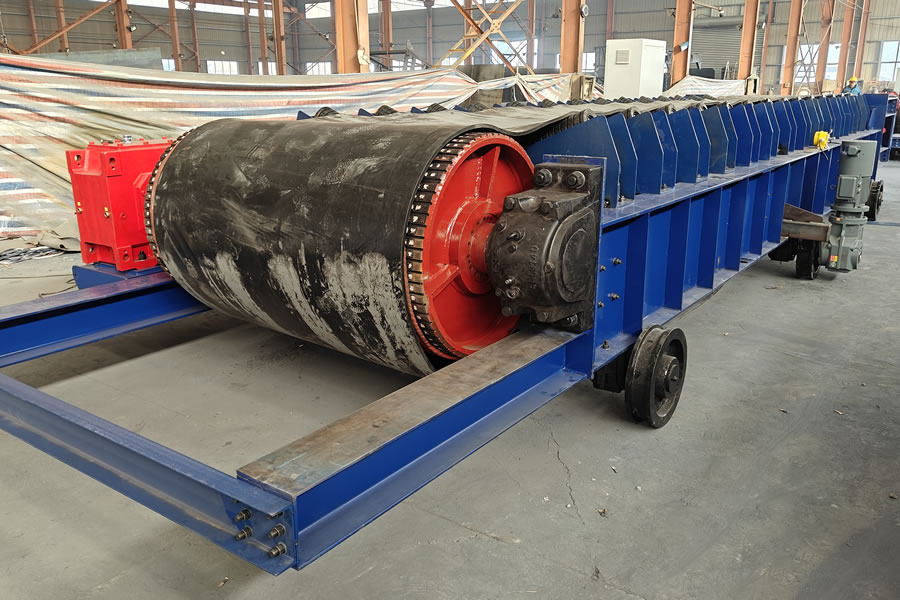
Belt Feeders are essential equipment for industrial material handling, serving industries such as mining, building materials, chemicals, metallurgy, and coal. They enable precise control and distribution of materials during processing and transportation.
1. Mining Industry
Ore Extraction and Processing: During the mining process, feeders are used to transport raw ores extracted from the mine to the primary crusher. For example, in large open-pit iron mines, ores of various sizes are conveyed by vibrating feeders at a controlled speed and flow to jaw crushers for coarse crushing. This helps optimize the crusher’s performance and prevents blockages or excessive wear due to uneven feeding.
Ore Dressing Operations: In ore processing plants, feeders play a crucial role in different stages of mineral processing. For instance, before flotation, feeders deliver crushed and ground slurry evenly to the flotation cells, ensuring effective contact between valuable mineral particles and reagents to improve separation efficiency.
2. Building Materials Industry
Cement Production: Feeders are essential throughout the cement production process—from raw material extraction to final packaging. During the raw material feeding phase (e.g., limestone, clay), belt feeders precisely control the feed rate into the raw mill. In the packaging phase, screw feeders accurately dose cement into bags by weight, ensuring product consistency.
Sand and Gravel Production: In aggregate production lines, vibrating feeders are used to transport raw stone from stockpiles to crushers. Since different sizes of finished materials are needed, feeders work with screening equipment to adjust the feeding rate according to particle size and production requirements, ensuring compliance with standards.
3. Chemical Industry
Fertilizer Manufacturing: Accurate raw material feeding is essential in fertilizer production. In compound fertilizer plants, multiple materials must be blended according to specific formulas. Loss-in-weight feeders can precisely control the feed rate of each component to meet nutrient ratio requirements.
Plastic Production: In plastic pellet production, feeders deliver raw plastic materials to extruders or injection molding machines. For high-precision plastic products, such as automotive parts, feeders ensure accurate proportions of multiple plastic resins and additives to meet performance and quality standards.
4. Metallurgical Industry
Ironmaking and Steelmaking: Feeders deliver iron ore, coke, and limestone to blast furnaces based on precise ratios. For instance, a large blast furnace may require several thousand tons of raw materials daily. Belt feeders integrated with batching systems ensure stable, accurate raw material feeding for efficient furnace operation. In steelmaking, feeders are used to feed alloying elements into furnaces to achieve desired chemical compositions.
5. Coal Industry
Coal Mining and Preparation: In underground coal mining, feeders transport coal extracted by shearers to scraper conveyors and other transfer equipment. In coal preparation plants, feeders deliver raw coal evenly to washing and separation systems.
Previous: None.
Copyright:@2020-2021

Comments Please sign in or sign up to post.
0
0 of 500 characters used