
In industries where accuracy at the nanometer scale is critical, ultra-precision diamond tools have emerged as a foundational technology. These tools—often crafted from either natural or synthetic single-crystal diamonds—are enabling breakthroughs across optics, electronics, and aerospace components.
Diamond stands among the hardest natural materials, boasting exceptional wear resistance, high strength, and low friction—qualities that make it ideal for cutting, grinding, and shaping with extreme precision. When sharpened to tens of nanometers, these tools deliver ultra-fine resolution and significantly outperform conventional abrasives like silicon carbide.
One of the most refined processes using such tools is single-point diamond turning (SPDT)—a method to machine aspherical optical elements with sub-nanometer surface finishes and sub-micrometer form accuracy.
Beyond raw hardness, the crystal orientation of diamonds plays a pivotal role. Synthetic single-crystal diamonds have enabled uniform, high-quality cutting edges, overcoming variability seen with natural diamonds. Ground accurately to less than 50 nm sharpness and free from surface irregularities, they facilitate flawless mirror finishes at nanometer scales.
Advanced variants—including UPC-R, UPC-T, Nano-micro Forming Tools, and BL-UPC (binderless nano-polycrystalline diamond)—have been developed to meet demands such as aspherical lens mold processing, microscale patterning, and ultra-smooth carbide finishing (achieving surface roughness Ra ≈ 3.5 nm).
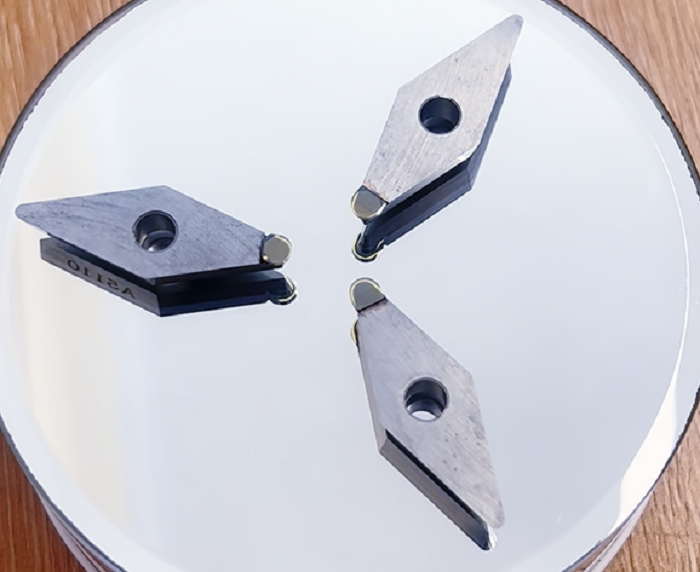
Ultra-precision diamond tools are vital for crafting:
Optical components: infrared mirrors, telescopes, laser optics, aspheric and silicon lens molds, and precision prisms
Smartphone camera and DVD lens molds: high-precision aspheric forms with ultra-fine finishes
Micro-patterned molds: nanogroove tools with sub-micron cutting edges enable micro-indentations impossible with lithography
Laser optics & parabolic mirrors: precise diamond tools produce high-reflectivity surfaces for high-power laser systems
Advanced optical instruments: cutting machines achieve <10 nm RMS surface roughness and sub-micrometer accuracy for near-infrared imaging devices
Leading manufacturers are equipping specialized single-crystal and polycrystalline tools for exacting industries. Their offerings include consistent ultra-sharp edges, reliable relapping services, and global repair networks. Customization options for turning, milling, fly-cutting, and engraving provide flexibility for industries from ophthalmics to aerospace.
Beyond traditional diamond tooling, femtosecond laser photoablation has shown remarkable promise. It enables damage-free diamond machining with ultra-fine surface finishes (Ra < 0.1 µm), preserving the diamond’s crystalline structure and avoiding thermal damage. This advancement is opening pathways for new generations of precision tools.
Ultra-precision diamond tooling has evolved into an indispensable technology for high-performance manufacturing—enabling nanometer-scale precision, microscale patterning, and enhanced surface integrity. Innovations in synthetic materials, tool geometry, and machining methods continue pushing the boundaries of what can be achieved.
Key highlights:
Tools engineered with specific crystal orientations for maximum sharpness and durability
Wide-ranging applications in optics, electronics, and mold fabrication
Leadership from specialized manufacturers offering end-to-end solutions
Emerging technologies like laser machining promising next-level precision without wear or heat damage
As industries demand ever-finer tolerances and new geometries, ultra-precision diamond tools—and their evolving technologies—will remain central to precision manufacturing’s future.
Previous: UV Sterilizer for Water Treatment: Ensuring Safe and Clean Water
Next: Why Should You Choose a Non-Sparking Axe for Hazardous Work Environments?
Copyright:@2020-2021

Comments Please sign in or sign up to post.
0
0 of 500 characters used