
The global construction industry is evolving rapidly, driven by demands for faster project completion, enhanced durability, and eco-friendly materials. Among the critical innovations, calcium formate 98% has emerged as a game-changer in cementitious systems. This white crystalline powder, also known as calcium methanoate, accelerates cement hydration, reduces setting time, and improves early strength—all while maintaining environmental safety. This article explores the technical advantages, applications, and market trends of industrial-grade calcium formate 98% in modern construction.
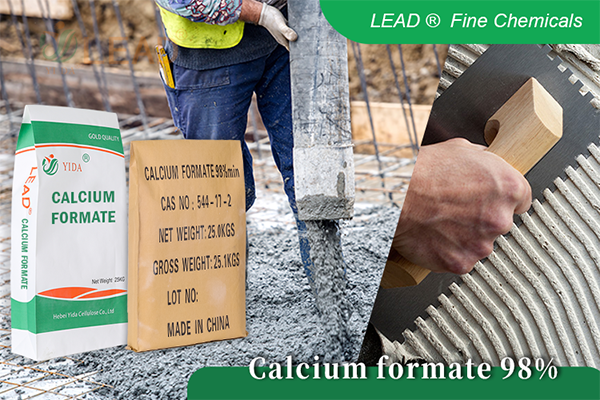
Calcium formate (CAS No. 544-17-2) is an inorganic compound with the molecular formula Ca(HCOO)₂. The 98% purity grade, widely used in construction, is a free-flowing white powder with:
Solubility: 16 g/100 mL (20°C) in water, ensuring rapid dissolution in cement mixes.
pH: Neutral (7.0–7.5 in 10% aqueous solution), minimizing corrosion risks to steel reinforcement.
Particle Size: Typically 200–300 mesh, optimized for uniform dispersion in concrete.
Unlike traditional chloride-based accelerators (e.g., calcium chloride), calcium formate 98% is non-corrosive and non-toxic, making it compliant with global standards such as ASTM C494 and EN 934-2.
Cement hardening relies on the hydration of tricalcium silicate (C₃S) and dicalcium silicate (C₂S). Calcium formate 98% acts as a nucleation agent, promoting the formation of calcium silicate hydrate (C-S-H) gels—the primary binder in concrete. Studies show that adding 0.5–1.5% calcium formate 98% by cement weight can:
Reduce initial setting time by 30–50%.
Achieve 5–8 MPa compressive strength within 8 hours (vs. 2–3 MPa for plain concrete).
In cold climates, cement hydration slows significantly below 5°C, leading to prolonged stripping times and increased labor costs. Calcium formate 98% lowers the activation energy of hydration reactions, enabling:
Effective performance at -10°C.
2–3 times faster strength gain compared to chloride-based alternatives at sub-zero temperatures.
Despite its accelerating effect, calcium formate 98% does not compromise workability. It acts as a mild plasticizer, reducing water demand by 5–10% while maintaining slump. Additionally, it refines pore structure, improving resistance to:
Freeze-thaw cycles.
Chloride ion penetration (critical for marine structures).
Carbonation (extending service life in aggressive environments).
Manufacturers of precast slabs, pipes, and railway sleepers rely on calcium formate 98% to achieve:
24-hour stripping strength of 15–20 MPa, enabling rapid mold turnover.
Reduced energy costs by eliminating heated curing chambers.
Case Study: A European precast plant reported a 40% increase in daily production after switching to calcium formate 98%, with no compromise on product quality.
In tile adhesives and self-leveling compounds, calcium formate 98% ensures:
Open time of 30–60 minutes (adjustable via dosage).
Early grip strength of ≥0.5 MPa within 4 hours, preventing tile slippage.
For sprayable concrete in tunneling, calcium formate 98% improves:
Rebound loss reduction by 15–20%.
28-day strength of 40–50 MPa, meeting international tunneling standards.
In regions like Canada and Scandinavia, calcium formate 98% is indispensable for:
Winter road repairs, enabling traffic resumption within 6 hours.
Foundation pouring in sub-zero temperatures without anti-freeze admixtures.
General-purpose concrete: 0.5–1.0% by cement weight.
Cold weather applications: 1.0–1.5% (adjust based on ambient temperature).
Ultra-early strength requirements: Up to 2.0% (verify via trial mixes).
Calcium formate 98% is compatible with:
Portland cement (all types).
Superplasticizers (e.g., polycarboxylate ethers).
Air-entraining agents and retarders.
Avoid mixing with:
Nitrate-based accelerators (risk of gas formation).
High-alkali cements (potential pH-driven degradation).
Unlike calcium chloride, calcium formate 98% does not induce steel reinforcement corrosion, ensuring compliance with:
ACI 318 (U.S. concrete design code).
Eurocode 2 (European concrete standards).
Classified as non-hazardous under GHS, calcium formate 98% poses minimal health risks during handling. It is widely used in:
Animal feed (as a preservative and digestive aid).
Leather tanning (as a masking agent).
Leading manufacturers produce calcium formate 98% via:
Neutralization of formic acid with calcium carbonate, minimizing waste.
Closed-loop water recycling systems, reducing freshwater consumption by 70%.
The global calcium formate market is projected to grow at a CAGR of 5.2% through 2030, driven by:
Infrastructure investments in emerging economies (e.g., India’s $1.4 trillion National Infrastructure Pipeline).
Green building certifications (LEED, BREEAM) favoring low-chloride admixtures.
Innovations in 3D-printed concrete, where calcium formate 98% enables rapid layer bonding.
In an era of cost pressures and sustainability mandates, calcium formate 98% offers a compelling value proposition:
Faster project timelines via accelerated strength development.
Lower lifecycle costs through enhanced durability.
Regulatory compliance with global construction standards.
Whether you’re producing precast elements, repairing winter roads, or constructing high-rise buildings, calcium formate 98% is the early strength agent of choice for discerning engineers and contractors worldwide.
Ready to optimize your concrete mixes? Contact a certified supplier today to request samples and technical datasheets for calcium formate 98%.
Copyright:@2020-2021

Comments Please sign in or sign up to post.
0
0 of 500 characters used