
If you work in the manufacturing or construction fields, the term “collets” is likely already familiar. Collets come in a variety of types and serve many different industrial applications. In this article, the focus will be on collets used in rotary tool holders, which are commonly applied in CNC machining (such as milling operations).
Before diving into the details, it is important to first understand how collets function, the factors that affect their performance, proper maintenance practices to extend their lifespan, and the key signs that indicate when they should be replaced.
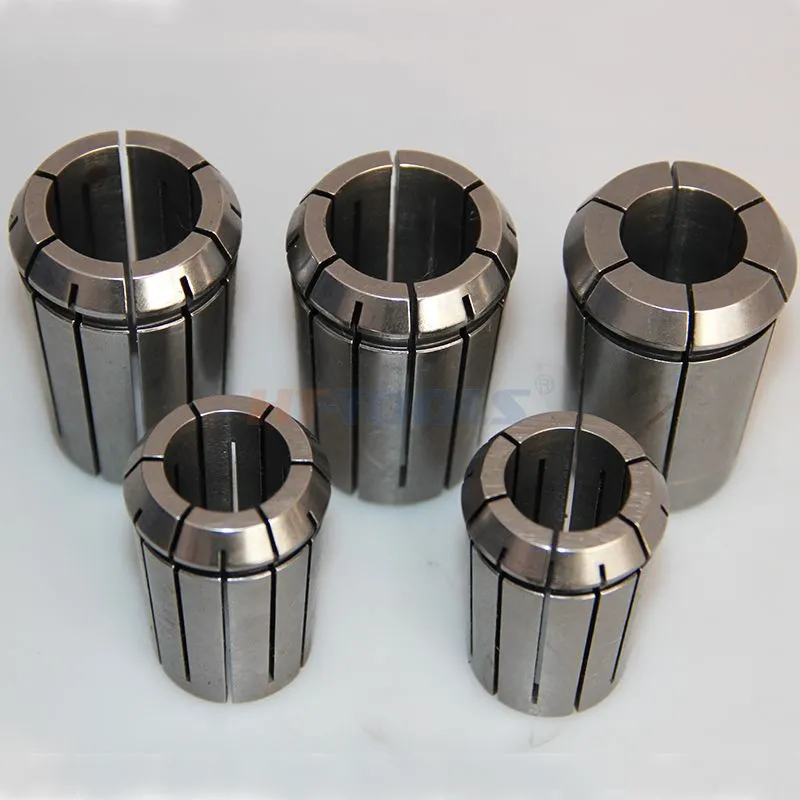
Collets serve as the essential link between the cutting tool and the tool holder (also known as a collet chuck). Typically, collets are round, tapered, and slotted in design. Their purpose is to grip the shank of a cutting tool securely, distributing clamping force evenly around the central bore.
To gain a clearer understanding, it is useful to first examine the basic structure of collets and the overall collet chuck system. The diagrams below illustrate the main components of a collet and a collet chuck, providing a foundation for further discussion.
The base of a collet is designed with a taper that fits precisely into the matching taper of the collet chuck body. This tapered connection ensures that when the collet is tightened by the collet nut, it is automatically centered within the chuck. This centering effect provides a high level of accuracy and concentricity, far greater than that offered by drill chucks or side-lock tool holders.
When the collet is drawn into the pocket by the collet nut, the slotted design allows its inner bore to contract and firmly grip the shank of the cutting tool. This mechanism produces strong, uniform clamping pressure, securing the tool with excellent rigidity. In addition, the taper-to-taper fit between the collet and the chuck helps minimize tool runout (T.I.R.), improving machining precision and surface finish quality.
Collets are available in various designs and sizes, each with distinct features that make them suitable for specific machining applications. Below is an overview of three commonly used collet types, along with their advantages and limitations.
Double-angle collets have been in use for many years and are still found in some machining setups. However, their design presents several challenges.
These collets typically grip the cutting tool shank using only two opposing contact points within the bore. While they are manufactured with multiple slots to create four clamping faces, tightening them toward the lower end of their collapse range often results in only two faces making effective contact.
This uneven clamping may lead to tool runout when inspected and can also cause tool deflection during cutting. As a result, users may experience excessive chatter, reduced tool life, and poor surface finish quality.
TG collets generally provide more holding power than double-angle designs due to their higher number of slots, which allows for additional contact points around the tool shank. They can be effective for larger diameter cutting tools, but there are trade-offs:
The relatively large size of the collet nut can limit accessibility in deep pocket milling, sometimes requiring extended-length tools.
Their small collapse range means that each collet is intended for a single tool shank size, offering less flexibility compared to other systems.
On the positive side, the geometry of the taper provides strong clamping force, making TG collets a practical choice for longer tools that need added stability.
Among the most widely used designs, ER collets are valued for their versatility and adaptability. They can hold a range of tool shanks, such as drills, end mills, and taps, and are also compatible with coolant-through tools.
ER collets typically offer a holding range of 0.020” to 0.040”, which reduces the number of collets needed to cover various tool diameters.
Their popularity has led to numerous variations, including designs specifically for tapping, quick-change operations, or rigid tapping with float compensation.
Some models incorporate special slotting or coolant channels, enabling efficient coolant delivery directly to the cutting area and supporting modern high-performance machining requirements.
Collets are precision wear components within a tool-holding system, and proper maintenance is essential to maintain accuracy and extend their service life. It is important to keep in mind that collets are the softest part of the assembly and are intentionally designed to wear out over time.
In a typical collet-based tool-holding system, the spindle is harder than the collet chuck, meaning any wear between them generally occurs on the chuck rather than the spindle—helping to protect this costly machine component. Collets, being softer than both the chuck body and the cutting tool, take on most of the wear forces. This is intentional, as collets are usually the most affordable part of the system and can be replaced more frequently without significant cost.
Once a collet is worn, it can no longer provide the same level of accuracy or rigidity. The consequences include increased chatter, reduced dimensional precision, and shorter tool life. As a general guideline, collets should be replaced every 4–6 months, depending on usage, to keep the tool-holding system performing at its best. Replacing collets on schedule is far less expensive than dealing with prematurely worn cutting tools.
Clean the outer surface of the collet with a cloth, and use a brass brush to remove debris from the internal bore. Small fragments, such as broken tool ends, can become lodged inside and reduce effectiveness.
Before initial use, spray a light cleaning solution on new collets and wipe them thoroughly. This helps remove the protective coating applied during packaging, which can otherwise interfere with gripping performance.
Always check the slots for debris. Any obstruction can reduce clamping force and lead to runout. Use a thin object, such as the tip of a knife, to carefully clear the slot if necessary.
Previous: Ring Forging: Process, Advantages, and Industrial Applications
Next: Zirconia Flap Disc: The Ultimate Solution for Efficient Metal Grinding and Finishing
Copyright:@2020-2021

Comments Please sign in or sign up to post.
0
0 of 500 characters used