
Lithium Niobate (LiNbO₃) wafers have become one of the most essential materials in modern high-frequency RF (radio frequency) systems, particularly in devices such as RF filters, surface acoustic wave (SAW) devices, bulk acoustic wave (BAW) resonators, modulators, and high-speed communication components. The exceptional electro-optic, piezoelectric, and nonlinear optical properties of lithium niobate enable it to support signal processing at extremely high frequencies with outstanding stability and efficiency.
When designing RF systems used in 5G infrastructure, satellite communications, radar systems, and optical modulation platforms, selecting the right lithium niobate wafer is a critical step. The wafer’s crystal orientation, purity, thickness, surface quality, and fabrication method directly influence device performance, frequency response, and signal integrity.
In this guide, we outline precisely how to evaluate and choose lithium niobate wafers for demanding high-frequency RF applications, ensuring optimal electrical performance and long-term reliability.
Lithium niobate is widely used because it combines strong piezoelectric coupling, high Curie temperature, and excellent dielectric properties. These characteristics allow RF devices fabricated on lithium niobate to operate at GHz frequencies with minimal signal distortion.
Key intrinsic material advantages include:
High electromechanical coupling coefficient
Wide transparency range
Low dielectric loss
Excellent temperature stability
Strong nonlinear optical response
These features make lithium niobate particularly suitable for high-frequency RF acoustic devices, where precise signal conversion between electrical and acoustic waves is required.
However, achieving the desired performance depends heavily on selecting wafers with the correct structural and material specifications.
One of the most important parameters when selecting lithium niobate wafers is the crystal cut orientation. The orientation determines how acoustic waves propagate through the crystal and how efficiently electrical signals convert into mechanical vibrations.
The most common crystal orientations used in RF devices include:
This orientation is widely used for SAW filters because it offers:
High electromechanical coupling
Excellent temperature stability
Strong acoustic wave confinement
These properties make 128° Y-cut LiNbO₃ wafers ideal for high-frequency wireless communication devices.
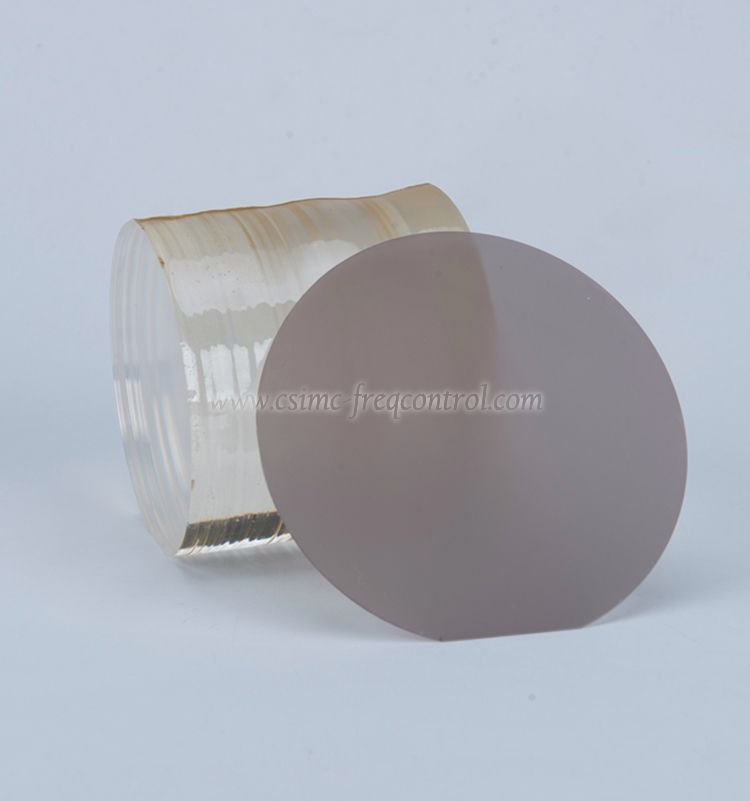
Standard Y-cut wafers provide balanced piezoelectric performance and are commonly used in:
RF resonators
Acoustic delay lines
Sensors
Z-cut wafers are typically used in electro-optic modulators and photonic applications, where optical waveguides must interact efficiently with RF signals.
Selecting the correct orientation ensures maximum acoustic wave efficiency and frequency stability in RF circuits.
Lithium niobate wafers are available in multiple diameter standards, including:
2 inch
3 inch
4 inch
6 inch
For modern RF device manufacturing, 4-inch and 6-inch wafers are preferred because they allow higher production yield and compatibility with semiconductor fabrication lines.
Wafer thickness directly influences:
Acoustic wave propagation
Device miniaturization
Mechanical stability
Typical thickness values include:
350 µm
500 µm
700 µm
For high-frequency RF applications, thinner wafers often provide better acoustic coupling and improved signal response. However, mechanical strength must also be considered to prevent wafer breakage during processing.
High-frequency RF devices require extremely smooth wafer surfaces to ensure accurate photolithography and electrode deposition.
Important surface quality parameters include:
A typical requirement for RF device wafers is:
Ra ≤ 0.5 nm
Ultra-low roughness minimizes signal scattering and acoustic losses.
Most RF device fabrication processes require double-side polished lithium niobate wafers, offering:
Uniform thickness
Superior bonding compatibility
High photolithography precision
For precision RF device fabrication, TTV must typically remain:
≤ 5 µm
Low TTV ensures consistent acoustic behavior across the wafer.
The crystal growth method significantly affects lithium niobate wafer quality. The most widely used method is the Czochralski crystal growth process, which produces high-purity single crystals with uniform composition.
High-quality RF wafers typically exhibit:
Low defect density
Minimal crystal dislocations
Uniform lithium distribution
Impurities or crystal defects can cause acoustic attenuation, frequency drift, and device instability, making purity an essential factor when selecting wafers.
In some advanced RF and photonic applications, lithium niobate wafers are doped with specific elements to enhance performance characteristics.
Common doping options include:
MgO-doped lithium niobate offers:
Improved resistance to photorefractive damage
Higher optical power tolerance
Better thermal stability
This doping is particularly useful in RF-optical hybrid devices and modulators.
These dopants can modify the electrical conductivity and optical properties of the crystal, depending on the target device application.
Selecting the appropriate doping profile ensures optimized device efficiency and long-term reliability.
For high-precision semiconductor processing, wafer edges must be carefully prepared to avoid contamination or mechanical damage.
Critical parameters include:
Chamfered or rounded edges
Edge polishing
Particle contamination control
Proper edge finishing prevents micro-cracks and particle generation, which could otherwise compromise RF device yield.
Modern RF device manufacturing often integrates lithium niobate wafers with advanced semiconductor technologies, including:
Thin-film lithium niobate (TFLN) platforms
Lithium niobate on insulator (LNOI) wafers
Hybrid silicon photonics integration
When selecting wafers for such applications, engineers must evaluate:
Bonding compatibility
Thermal expansion coefficients
Surface chemistry for wafer bonding
Thin-film lithium niobate has recently gained significant attention due to its ability to support ultra-high-frequency RF modulators exceeding 100 GHz bandwidth.
High-frequency RF systems often operate in environments where temperature fluctuations can impact signal accuracy. Lithium niobate wafers must therefore demonstrate strong thermal and mechanical stability.
Important thermal parameters include:
Curie temperature (~1210°C)
Low dielectric loss at GHz frequencies
Stable piezoelectric coefficients across temperature ranges
Selecting wafers with consistent thermal properties ensures stable RF device performance in demanding operational environments such as telecommunication base stations, aerospace systems, and radar platforms.
Before integrating lithium niobate wafers into RF device production, manufacturers should ensure the wafers undergo comprehensive quality inspection.
Typical quality control procedures include:
X-ray diffraction (XRD) crystal orientation verification
Surface interferometry testing
Optical inspection for defects
Thickness uniformity measurement
Particle contamination analysis
Reliable suppliers provide detailed wafer specifications and inspection reports, ensuring the material meets strict semiconductor-grade standards.
Selecting the right supplier is just as important as selecting the wafer specifications. A reputable manufacturer should provide:
Consistent crystal quality
Advanced wafer polishing capabilities
Custom orientation and thickness options
Strict semiconductor cleanroom processing
Stable supply chain for large-scale production
Trusted suppliers typically maintain ISO-certified manufacturing environments and offer comprehensive technical support for RF device engineers.
Selecting the right lithium niobate wafer for high-frequency RF applications requires careful evaluation of multiple factors, including crystal orientation, wafer thickness, surface quality, purity, doping, and compatibility with modern semiconductor fabrication processes. Each parameter directly influences the acoustic efficiency, signal integrity, and operational stability of RF devices operating in the GHz frequency range.
By prioritizing high-quality crystal growth, precision wafer polishing, and strict quality control, engineers can ensure optimal material performance for next-generation RF technologies such as 5G communication systems, advanced radar platforms, and high-speed optical modulators.
Properly selected lithium niobate wafers form the foundation of reliable, high-performance RF components, enabling the continued advancement of high-frequency electronics and modern communication infrastructure.
For more details please contact CQT
Previous: Material Trade-Offs Engineers Consider When Selecting Piezoelectric Wafers
Next: None.
Copyright:@2020-2021

Comments Please sign in or sign up to post.
0
0 of 500 characters used