
Lithium Tantalate (LiTaO₃) wafers are widely used in Surface Acoustic Wave (SAW) devices, which are essential components in modern RF filters, wireless communication modules, sensors, and signal processing systems. With the rapid expansion of 5G networks, IoT devices, and high-frequency communication technologies, the demand for high-performance SAW substrates has increased significantly.
Lithium tantalate stands out among piezoelectric materials because of its excellent temperature stability, strong electromechanical coupling, and low acoustic loss, making it ideal for manufacturing SAW filters that operate at high frequencies with precise signal control.
Choosing the correct lithium tantalate wafer requires careful evaluation of several critical parameters. These factors directly affect device efficiency, frequency response, manufacturing yield, and long-term stability. Understanding the key selection criteria helps engineers and manufacturers ensure optimal SAW device performance.
One of the most important factors when selecting lithium tantalate wafers for SAW devices is the crystal orientation, often referred to as the cut angle. The orientation determines how acoustic waves propagate across the surface of the wafer and influences the electromechanical properties of the device.
Different cut angles are optimized for different applications.
The 36° Y-cut lithium tantalate wafer is one of the most widely used substrates for SAW filters. It offers several advantages:
Excellent temperature stability
Low propagation loss
Stable frequency characteristics
Good power durability
Because of these benefits, 36° Y-cut wafers are commonly used in mobile communication RF filters and duplexers.
The 42° Y-cut orientation provides higher electromechanical coupling, which improves signal conversion efficiency. This orientation is typically selected for:
High-frequency SAW filters
Advanced communication devices
Precision sensors
Choosing the correct orientation ensures optimal acoustic wave propagation and minimal signal distortion.
The electromechanical coupling coefficient (k²) is a critical parameter that describes how efficiently electrical signals are converted into acoustic waves within the SAW device.
Lithium tantalate provides a higher coupling coefficient compared to quartz, allowing devices to achieve:
Wider bandwidth
Higher frequency operation
Improved signal efficiency
For high-performance SAW filters used in smartphones and wireless communication modules, wafers with a high and stable coupling coefficient are essential.
CQT Lithium tantalate wafers are manufactured in several standard sizes to accommodate different fabrication processes.
Typical wafer diameters include:
2 inch wafers
3 inch wafers
4 inch wafers
6 inch wafers
Modern SAW device manufacturing increasingly favors 4-inch and 6-inch wafers, as they provide higher production efficiency and compatibility with semiconductor fabrication equipment.
Wafer thickness influences mechanical strength and acoustic wave performance. Standard thickness values often include:
350 µm
500 µm
700 µm
Thinner wafers may enhance acoustic wave sensitivity, while thicker wafers provide better mechanical stability during fabrication.
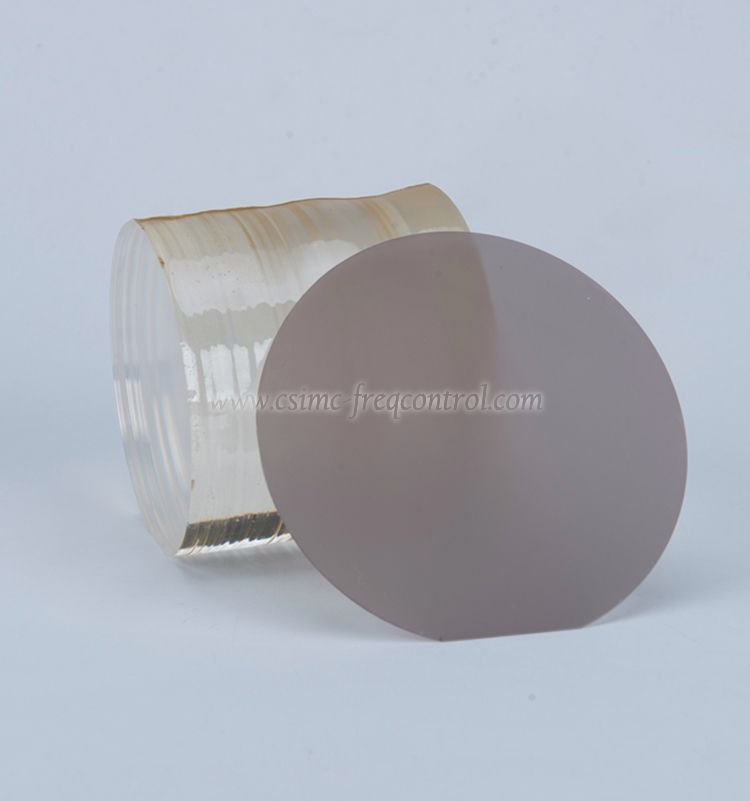
High-quality surface finishing is crucial for producing high-frequency SAW devices. The surface condition directly affects electrode patterning accuracy and acoustic wave propagation.
Key surface quality indicators include:
High-performance SAW wafers typically require:
Surface roughness (Ra) ≤ 0.5 nm
Smooth surfaces minimize acoustic scattering and signal attenuation.
Most SAW device fabrication processes require double-side polished lithium tantalate wafers, which provide:
Uniform thickness
High lithography precision
Improved wafer bonding capability
Uniform wafer thickness is essential for consistent SAW device fabrication.
TTV measures the variation in thickness across the wafer. High-quality wafers typically maintain:
TTV ≤ 5 µm
Low TTV ensures uniform acoustic wave propagation and consistent device performance.
Wafer warp and bow must also be tightly controlled to ensure compatibility with automated semiconductor processing equipment. Excessive warp can cause alignment errors during photolithography.
The performance of lithium tantalate wafers is strongly influenced by the quality of the single crystal structure.
High-quality wafers should exhibit:
Low dislocation density
Minimal internal stress
Uniform crystal lattice structure
Defects in the crystal can cause acoustic wave scattering, signal loss, and frequency instability in SAW devices.
Most high-quality wafers are grown using the Czochralski crystal growth method, which allows precise control over crystal composition and structural uniformity.
SAW devices often operate in environments where temperature variations occur. Therefore, lithium tantalate wafers must demonstrate excellent thermal stability.
Important thermal properties include:
Stable piezoelectric coefficients
Low temperature coefficient of frequency (TCF)
High Curie temperature
Lithium tantalate offers better temperature stability compared to some alternative piezoelectric materials, making it suitable for RF filters used in mobile communication systems.
Proper edge finishing improves wafer durability during fabrication.
Important edge characteristics include:
Rounded or chamfered wafer edges
Polished edges to reduce particle contamination
Resistance to micro-cracking
High-quality edge processing ensures the wafer can withstand handling, lithography, etching, and metallization processes used in SAW device manufacturing.
Modern SAW devices often incorporate advanced fabrication technologies, including:
Fine-line photolithography
High-frequency electrode patterning
Thin-film deposition processes
Lithium tantalate wafers must therefore provide:
Excellent surface uniformity
Strong adhesion compatibility
Chemical stability during etching processes
Wafers that meet semiconductor-grade standards allow manufacturers to achieve high production yields and reliable device performance.
Selecting a reputable lithium tantalate wafer supplier is essential for maintaining consistent SAW device quality.
Reliable suppliers typically provide:
Detailed wafer specifications
Material certification reports
Strict quality control procedures
Semiconductor-grade cleanroom processing
Certifications such as ISO quality standards often indicate a manufacturer’s ability to deliver consistent and high-quality wafer products for RF device fabrication.
Choosing the right lithium tantalate wafer for SAW devices requires careful evaluation of multiple technical parameters. Critical factors include crystal orientation, electromechanical coupling coefficient, wafer size, surface quality, thickness uniformity, crystal purity, and thermal stability.
By selecting wafers that meet strict performance and manufacturing requirements, engineers can ensure optimal acoustic wave propagation, high-frequency signal accuracy, and long-term reliability in SAW filters and RF components.
As wireless communication technologies continue to evolve, high-quality lithium tantalate wafers will remain a fundamental material enabling the next generation of high-performance SAW devices.
Previous: How Material Properties Impact Frequency Stability in SAW Devices
Next: None.
Copyright:@2020-2021

Comments Please sign in or sign up to post.
0
0 of 500 characters used