
In the competitive construction industry, gypsum board plays a vital role as a versatile building material, commonly used for walls and ceilings. To ensure profitability and competitiveness in gypsum board manufacturing, optimizing the production line efficiency is crucial. By enhancing the manufacturing processes, improving energy efficiency, and ensuring consistent quality, manufacturers can reduce costs, boost productivity, and increase their market share.
Gypsum board, also known as drywall, plasterboard, or sheetrock, is a panel made from gypsum plaster pressed between two layers of thick paper. Due to its fire resistance, soundproofing properties, and ease of installation, it is widely used in interior construction, particularly for wall and ceiling applications.
The production of gypsum board involves extracting and processing gypsum rock, mixing it with additives such as starch, foaming agents, and accelerators, then forming and drying the mixture to produce boards in various sizes.
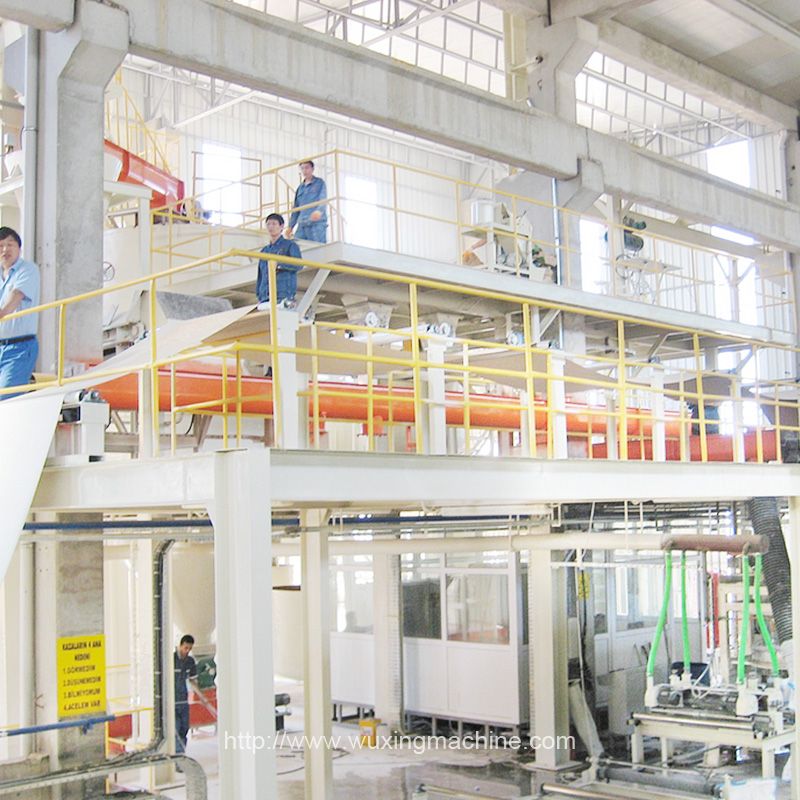
Efficient gypsum board production depends on optimizing several stages of the manufacturing process. The key components of the gypsum board production line include:
Raw Material Preparation
Mixing and Forming
Drying and Curing
Cutting and Shaping
Packaging and Distribution
Each stage plays an important role in ensuring the quality, efficiency, and consistency of the final product.
Despite its widespread use, gypsum board production faces several challenges that can impede productivity and increase costs. These include:
Raw material variability
Equipment downtime
Inefficient processes
Inadequate quality control
Energy inefficiencies
Addressing these challenges through continuous improvement is essential for maintaining a competitive edge.
To improve production efficiency, optimizing raw material handling is key. This involves:
Sourcing high-quality gypsum and additives to ensure optimal board properties.
Implementing effective stockpiling and inventory management to reduce waste and avoid production delays.
Ensuring that raw materials are stored and handled properly to prevent contamination, which could affect the quality of the final product.
Proper raw material handling helps minimize waste and ensures consistent product quality, reducing costs in the long run.
Streamlining the manufacturing process is vital for improving efficiency. Consider the following strategies:
Regular maintenance and calibration of machinery to minimize breakdowns and downtime.
Advanced automation systems that improve consistency, reduce errors, and increase overall production capacity.
Lean manufacturing principles, which focus on eliminating waste and optimizing resources to reduce inefficiencies.
By improving manufacturing processes, you can significantly boost your production rate while minimizing defects and rework.
Quality control plays a crucial role in ensuring that gypsum boards meet both industry standards and customer expectations. Implementing stringent quality control measures at each production stage—raw material inspection, in-process checks, and final inspections—helps maintain high standards.
Monitoring and testing protocols should be set at each stage.
Immediate feedback loops to address production deviations quickly.
By focusing on quality control, manufacturers can reduce defects, improve customer satisfaction, and build a strong reputation in the market.
Energy costs are a significant part of production expenses. Implementing energy-efficient technologies can lead to substantial savings while also reducing the environmental footprint.
Key energy-saving measures include:
Heat recovery systems to capture and reuse excess heat from the drying process.
Energy-efficient lighting like LED systems.
Optimized drying systems that use less energy and improve drying time.
By focusing on energy efficiency, manufacturers can cut costs and contribute to environmental sustainability.
A skilled workforce is essential for maximizing operational efficiency. Investment in training programs and continuous learning can:
Improve machinery operation and maintenance.
Enhance troubleshooting skills and reduce downtime.
Boost employee morale and productivity.
Having a well-trained and motivated workforce ensures smooth operations and a safer, more productive work environment.
Once the boards are produced, efficient logistics and distribution systems are essential for timely delivery and customer satisfaction. Key strategies include:
Optimized inventory management systems that ensure you never run out of materials or overstock.
Advanced transportation management for on-time delivery to customers.
By streamlining logistics and distribution, manufacturers can improve customer relationships and reduce costs associated with delayed shipments.
Manufacturers are increasingly focusing on sustainability in production. Sustainable practices include:
Recycling gypsum waste back into the production process.
Reducing overall carbon footprint through energy-efficient systems.
Using eco-friendly additives and materials to ensure the boards are both high-quality and environmentally responsible.
By focusing on sustainability, gypsum board manufacturers can not only reduce their environmental impact but also appeal to eco-conscious customers.
Optimizing gypsum board production requires a holistic approach that encompasses:
Efficient raw material handling
Streamlined manufacturing processes
Rigorous quality control
Energy-efficient technologies
Skilled workforce management
Sustainability initiatives
By implementing these strategies, gypsum board manufacturers can reduce costs, boost productivity, and remain competitive in an ever-evolving market.
How can automation improve gypsum board production efficiency?
Automation reduces manual intervention, enhances process consistency, and increases production capacity while reducing errors.
What role does quality control play in gypsum board manufacturing?
Quality control ensures that each batch of boards meets industry standards, minimizing defects and ensuring customer satisfaction.
Why is workforce training important for manufacturing efficiency?
A well-trained workforce improves machinery operation, reduces downtime, and contributes to a more productive work environment.
What are some energy-efficient technologies used in gypsum board production?
Heat recovery systems, energy-efficient lighting, and optimized drying processes are all essential for reducing energy consumption.
How can data analytics drive continuous improvement?
Data analytics provides real-time insights into production bottlenecks, resource utilization, and potential issues, allowing for informed decision-making and continuous process improvements.
Looking to boost the efficiency and profitability of your gypsum board production? Wuxing Machinery offers advanced gypsum board production lines that integrate automation, energy-efficient systems, and quality control measures to help you maximize output and reduce costs.
Contact us today to learn how we can help you streamline your gypsum board production line and stay competitive in the market.
Copyright:@2020-2021

Comments Please sign in or sign up to post.
0
0 of 500 characters used