
A Radio Remote Unit (RRU), also referred to as a Remote Radio Head (RRH), is an integral part of modern cellular networks. Its primary function is to bridge the gap between wireless devices and the cellular network infrastructure, ensuring seamless communication.
The RRU is responsible for transmitting and receiving signals between the base station and wireless devices. It converts data into radio frequency (RF) signals for transmission and processes incoming signals for the network.
Acting as a mediator, RRUs connect optical and electromagnetic signals, enabling efficient communication across varied technologies.
RRUs also manage additional equipment such as cooling systems and power units, ensuring optimal operation.
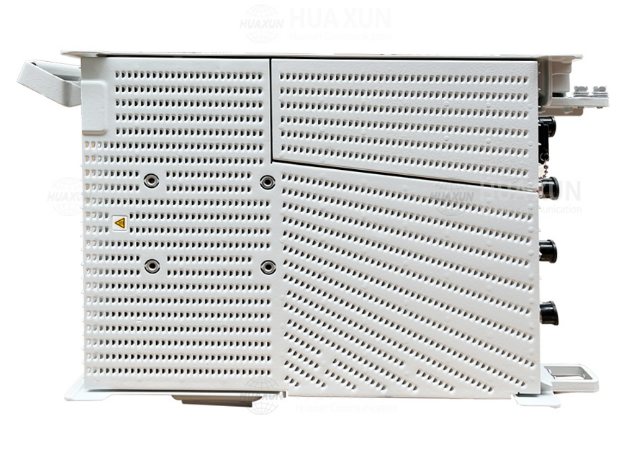
The transmit section of an RRU converts baseband data from the Base Band Unit (BBU) into RF signals. These signals are then emitted through antennas to reach user devices.
The receive section includes components like filters, low-noise amplifiers, mixers, and analog-to-digital converters. This system ensures incoming signals are processed with minimal distortion.
RRUs are typically installed near the antennas at the top of base stations. This proximity minimizes signal loss and maximizes coverage, especially in urban areas with dense infrastructure.
RRUs connect to the base station via fiber optic cables using the Common Public Radio Interface (CPRI). This ensures high-speed data transfer and efficient communication.
The RRU and BBU work in tandem to handle signal processing and transmission, forming the backbone of cellular networks.
- Extending rural coverage: Ensuring connectivity in remote areas.
- Improving urban services: Enhancing network capacity and reducing congestion.
- Addressing dead spots: Eliminating areas with weak or no signal.
Prominent RRU manufacturers include:
- Nokia: Known for innovative 5G solutions.
- Huawei: A leader in advanced RRU designs.
- Ericsson: Pioneering efficient network deployments.
- ZTE: Offering cost-effective RRU solutions.
As the telecom industry transitions to 5G, RRUs are pivotal in achieving ultra-low latency and high bandwidth. They support massive MIMO (Multiple Input, Multiple Output) technology, crucial for 5G performance.
With minimal signal loss and interference, RRUs ensure robust network performance.
By decentralizing network components, RRUs reduce infrastructure costs and save space.
While beneficial, deploying RRUs comes with challenges such as:
- Complex installations: Requires skilled technicians.
- Compatibility issues: Ensuring seamless integration with existing infrastructure.
Radio Remote Units (RRUs) are the unsung heroes of cellular networks, ensuring seamless connectivity in both urban and rural settings. From enabling 5G to addressing network dead spots, RRUs are revolutionizing how we communicate. With advancements on the horizon, the role of RRUs will only grow, shaping the future of wireless communication.
Previous: None.
Next: None.
Copyright:@2020-2021

Comments Please sign in or sign up to post.
0
0 of 500 characters used