
Thermal insulation plays a crucial role in modern wall construction, especially in energy-efficient residential, commercial, and industrial buildings. Among the most commonly used insulation materials, Rock Wool Board and glass wool board are popular choices because of their thermal insulation performance, fire resistance, and acoustic properties.
However, when comparing these two materials for wall insulation, thermal conductivity becomes one of the most important factors. Lower thermal conductivity generally means better insulation efficiency and improved energy savings. Understanding the differences between Rock Wool Board and glass wool board can help architects, contractors, and building owners choose the most suitable insulation solution for their projects.
As a professional insulation brand, Huana provides high-quality Rock Wool Board products designed for reliable thermal performance, fire protection, and long-term building efficiency.
Thermal conductivity measures how easily heat passes through a material. It is commonly expressed in W/m·K (watts per meter-kelvin).
A lower thermal conductivity value indicates that the material transfers less heat, meaning it provides better insulation performance.
For wall insulation systems, low thermal conductivity helps:
Reduce indoor heat loss
Improve energy efficiency
Lower heating and cooling costs
Enhance indoor comfort
Improve building sustainability
Both Rock Wool Board and glass wool board are designed to reduce heat transfer, but they perform differently under varying conditions.
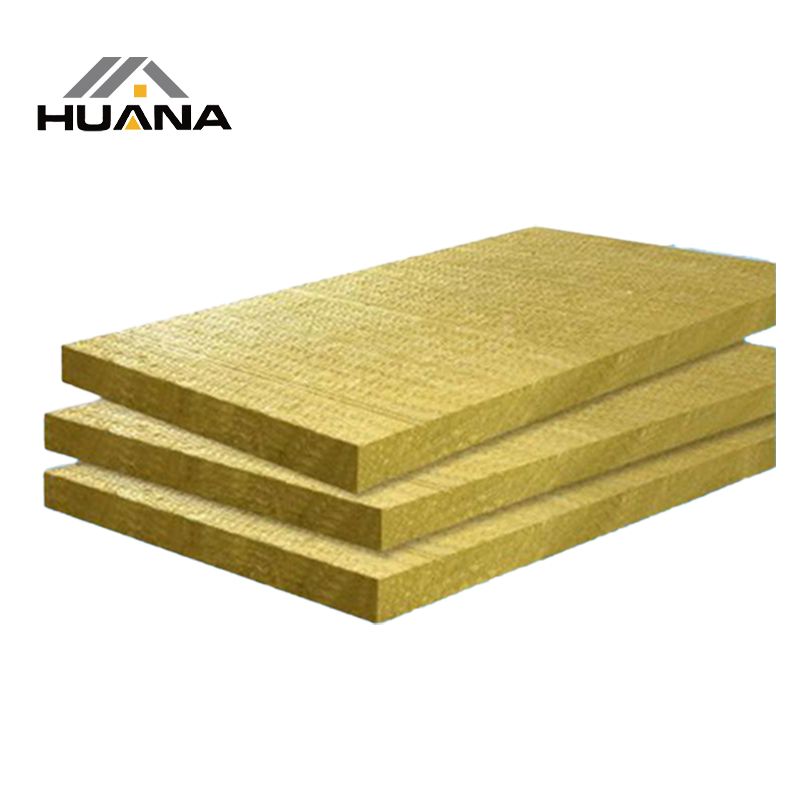
Rock Wool Board is a rigid insulation material made from natural basalt rock and other mineral materials. The raw materials are melted at high temperatures and spun into fine fibers before being compressed into boards.
Rock Wool Board is widely used in:
Exterior wall insulation
Curtain wall systems
Industrial buildings
Fireproof wall assemblies
Acoustic insulation systems
Huana manufactures Rock Wool products with stable thermal performance and strong fire-resistant properties for modern building applications.
Glass wool board is made from recycled glass and silica sand. The materials are melted and processed into lightweight fibrous insulation panels.
Glass wool board is commonly used in:
Interior partition walls
Residential insulation
HVAC systems
Ceiling insulation
Lightweight wall systems
Because of its lighter density, glass wool is often easier to handle during installation.
The thermal conductivity of Rock Wool Board typically ranges between 0.035 and 0.045 W/m·K depending on density and product specifications.
Key thermal advantages include:
Stable insulation performance at high temperatures
Consistent thermal resistance over time
Better thermal stability in demanding environments
Higher-density Rock Wool Board products can provide both thermal insulation and structural strength.
Glass wool board generally has thermal conductivity values ranging from 0.030 to 0.040 W/m·K.
In some low-density applications, glass wool may initially offer slightly lower thermal conductivity than certain rock wool products.
However, thermal performance can vary significantly depending on:
Density
Moisture exposure
Compression during installation
Long-term material stability
Wall insulation materials must maintain stable thermal performance under changing environmental conditions.
Rock Wool Board performs exceptionally well in high-temperature environments because of its mineral composition.
Advantages include:
Excellent thermal stability
High melting point
Low thermal deformation
Reliable insulation performance during fire exposure
This makes Rock Wool Board suitable for buildings requiring advanced fire protection.
Glass wool performs well in normal residential conditions, but prolonged exposure to high temperatures may reduce structural stability over time.
For high-rise buildings and industrial projects, rock wool often provides more reliable long-term performance.
Fire safety is another critical factor in wall insulation systems.
Rock Wool Board is naturally non-combustible and can withstand extremely high temperatures.
Benefits include:
Excellent fire containment
Reduced flame spread
Minimal smoke generation
Improved building safety
Huana produces Rock Wool Board solutions specifically designed for fire-rated wall systems.
Glass wool is also generally non-combustible, but its lower melting point means it may soften earlier under extreme fire conditions.
For projects with strict fire safety requirements, rock wool is often the preferred material.
Moisture can affect insulation efficiency over time.
Rock Wool Board typically offers:
Good water repellency
Vapor permeability
Stable thermal performance under humid conditions
This helps maintain long-term insulation efficiency in exterior wall systems.
Glass wool may lose some insulation effectiveness if moisture penetrates the material.
Wet insulation can reduce thermal resistance and potentially affect wall system performance.
In addition to thermal insulation, sound absorption is important for wall systems.
Because of its higher density, Rock Wool Board often provides superior sound insulation performance.
It is commonly used in:
Commercial buildings
Hotels
Recording studios
Industrial facilities
Glass wool also provides good acoustic absorption, especially in lightweight interior wall systems.
However, rock wool generally offers stronger low-frequency sound control.
The best insulation material depends on the project requirements.
Fire resistance is critical
High-temperature stability is required
Acoustic performance is important
Long-term durability is a priority
Exterior wall systems are involved
Lightweight insulation is preferred
Budget-sensitive projects are involved
Standard residential insulation is sufficient
Both Rock Wool Board and glass wool board offer effective thermal insulation for wall systems, but their performance differs depending on application conditions. While glass wool may provide slightly lower thermal conductivity in some cases, Rock Wool Board delivers superior fire resistance, thermal stability, durability, and acoustic performance.
For projects requiring reliable long-term wall insulation, Huana provides high-quality Rock Wool Board solutions engineered for energy efficiency, safety, and modern construction standards.
Previous: Weather-Resistant WPC Panels for Outdoor Use
Next: How to Cut Custom Rock Wool Board for Precise Construction Needs
Copyright:@2020-2021

Comments Please sign in or sign up to post.
0
0 of 500 characters used