
Choosing the right Flake Ice Machine is about more than selecting the largest production capacity. While manufacturers often advertise daily ice output, the actual amount of ice your business requires depends on operating conditions, industry demands, peak usage periods, and environmental factors. Selecting an oversized or undersized machine can lead to unnecessary costs or insufficient ice production.
This guide explains how Flake Ice Machine capacity is measured, what factors affect real-world output, and how Daxtro helps businesses choose the ideal ice-making solution for maximum efficiency and return on investment.
The capacity of a Flake Ice Machine is typically expressed as the amount of ice it can produce within 24 hours under standard testing conditions.
Common production capacities include:
· 500 kg/day
· 1 ton/day
· 3 tons/day
· 5 tons/day
· 10 tons/day
· 20 tons/day
· 30 tons/day or more
Industrial facilities may even require customized systems capable of producing over 100 tons of flake ice per day.
However, these ratings are measured under controlled laboratory conditions, which may differ from actual operating environments.
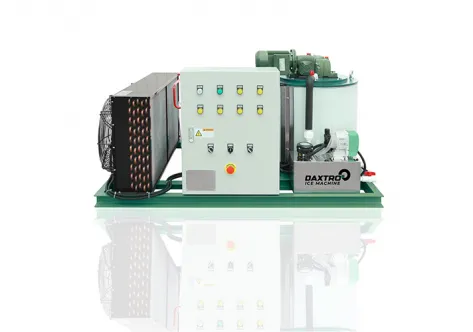
Manufacturers usually test Flake Ice Machine performance under standardized conditions, such as:
Most production ratings assume an air temperature of approximately 25°C (77°F).
Higher ambient temperatures increase refrigeration loads, reducing actual ice output.
Standard testing often uses water at around 20°C (68°F).
If incoming water is warmer, the refrigeration system must remove more heat, lowering daily production.
Consistent voltage and power quality are also assumed during testing.
Power fluctuations may reduce efficiency and affect production consistency.
In real-world applications, actual production can vary depending on several operating factors.
Facilities located in tropical or high-temperature regions generally experience reduced production capacity compared to laboratory ratings.
Proper ventilation around the Flake Ice Machine helps improve cooling efficiency.
Poor water quality can cause mineral deposits on the evaporator, reducing heat transfer efficiency and lowering ice output over time.
Installing appropriate water filtration systems helps maintain consistent performance.
Regular cleaning and preventive maintenance ensure the refrigeration system operates at peak efficiency.
Ignoring maintenance may result in:
· Lower ice production
· Higher energy consumption
· Increased repair costs
· Shorter equipment lifespan
Choosing the correct machine begins with understanding your daily ice demand.
Calculate the total amount of ice your operation uses during a normal working day.
For example:
· Seafood processing
· Meat production
· Supermarkets
· Concrete cooling
· Chemical processing
· Food manufacturing
Each industry has different cooling requirements.
Many businesses experience seasonal or daily production peaks.
Instead of sizing equipment only for average demand, include additional capacity to handle:
· Summer operations
· Holiday production
· High-volume processing days
· Business expansion
A safety margin of 10–20% is often recommended.
Some businesses require ice production around the clock, while others only need ice during working hours.
Continuous production may allow a smaller Flake Ice Machine to meet demand efficiently, whereas limited operating hours may require a larger unit.
Seafood facilities typically require continuous ice production for preserving freshly caught products.
Recommended capacity depends on:
· Daily processing volume
· Transportation needs
· Storage duration
Large processing plants often install multiple flake ice machines for operational flexibility.
Retail stores usually need smaller production capacities focused on fresh seafood displays and produce preservation.
Machines between 500 kg/day and several tons per day are common, depending on store size.
Food manufacturers often require consistent cooling during production.
Selecting a Flake Ice Machine with stable output ensures uninterrupted production while maintaining product quality.
Mining, chemical processing, and concrete cooling projects often require high-capacity systems capable of producing multiple tons of ice every day.
Capacity is important, but it should not be the only purchasing criterion.
An energy-efficient Flake Ice Machine reduces operating costs over its service life.
Look for:
· High-efficiency compressors
· Optimized evaporators
· Intelligent control systems
· Low electricity consumption
Producing sufficient ice is only part of the solution.
Adequate storage bins ensure ice remains available during periods of peak demand without overloading the machine.
Businesses planning to expand production should consider equipment that accommodates future demand.
Purchasing a machine with moderate additional capacity can eliminate the need for costly upgrades later.
Selecting a reliable manufacturer ensures long-term performance and dependable production.
Daxtro manufactures advanced Flake Ice Machine systems designed for high efficiency, reliable operation, and consistent ice quality. Using premium refrigeration components, stainless steel construction, and intelligent automation, Daxtro equipment delivers stable ice production while minimizing energy consumption and maintenance requirements.
Whether your business operates in seafood processing, supermarkets, food manufacturing, concrete cooling, or industrial refrigeration, Daxtro provides customized flake ice solutions tailored to your production goals and operational budget.
Before making your investment, consider the following best practices:
Base your decision on real production requirements rather than estimated averages.
Ensure your equipment can meet demand during the busiest operating periods.
Energy-efficient machines provide lower lifetime operating costs and faster return on investment.
Reliable equipment minimizes downtime and ensures consistent production over many years.
Understanding how Flake Ice Machine capacity is measured helps businesses make informed purchasing decisions. While advertised daily output provides a useful benchmark, actual production depends on environmental conditions, water quality, maintenance, and operational requirements.
Selecting the correct capacity ensures reliable ice production, improved efficiency, and lower operating costs. With advanced engineering, energy-efficient technology, and customized solutions, Daxtro offers high-performance flake ice machines that deliver dependable results for a wide range of commercial and industrial applications.
Previous: What are rubber O-rings used for?
Next: Pneumatic Grippers - Cylinders, Rotary Actuators & Grippers
Copyright:@2020-2021

Comments Please sign in or sign up to post.
0
0 of 500 characters used