
Selecting the right Flake Ice Machine is a crucial decision for businesses in seafood processing, food manufacturing, supermarkets, concrete cooling, and industrial refrigeration. While production capacity is often the first consideration, the cooling method is equally important. The two primary options—air-cooled and water-cooled systems—offer different advantages in terms of efficiency, installation, operating costs, and environmental suitability.
This guide compares air-cooled and water-cooled Flake Ice Machine systems, helping you determine which solution best fits your operational needs. You'll also learn how Daxtro delivers reliable, energy-efficient ice-making equipment for a wide range of industries.
A Flake Ice Machine produces ice by freezing a thin layer of water on the surface of an evaporator drum. During this process, the refrigeration system must continuously remove heat to maintain efficient ice production.
The difference between air-cooled and water-cooled machines lies in how they release this heat.
Air-cooled machines use condenser fans to transfer heat into the surrounding air. As warm refrigerant passes through the condenser, airflow carries the heat away, allowing the refrigerant to cool and continue the refrigeration cycle.
Water-cooled machines circulate water through the condenser to absorb heat. The warmed water is then discharged or recirculated through a cooling tower, depending on the system design.
Both methods effectively cool the refrigeration system, but their performance varies depending on installation conditions.
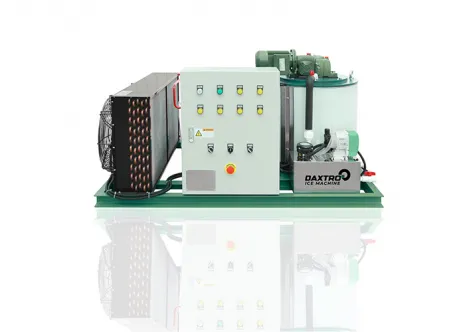
Air-cooled Flake Ice Machine models are among the most popular choices for commercial and medium-sized industrial applications.
Air-cooled machines require fewer supporting components because they do not need a separate cooling water system.
Installation is generally faster and involves:
· Electrical connection
· Water supply
· Drainage
· Adequate ventilation
This simplicity reduces installation costs and project complexity.
Since air is used as the cooling medium, these machines consume very little water beyond what is needed for ice production.
This makes them an environmentally friendly option in regions where water resources are limited or expensive.
Air-cooled condensers are relatively easy to inspect and clean. Routine maintenance typically includes:
· Cleaning condenser fins
· Checking fan motors
· Inspecting refrigerant levels
· Removing dust and debris
Proper maintenance ensures stable performance and long equipment life.
Air-cooled machines are ideal for:
· Restaurants
· Supermarkets
· Small seafood processors
· Food distribution centers
· Beverage manufacturers
· Commercial kitchens
They perform particularly well in moderate climates with sufficient airflow.
Water-cooled Flake Ice Machine systems are commonly selected for large industrial facilities operating in demanding environments.
Water transfers heat more efficiently than air. As a result, water-cooled condensers maintain stable refrigeration performance even when ambient temperatures are high.
This helps maintain consistent daily ice production during hot summer months or in tropical regions.
When a reliable cooling water source is available, water-cooled systems can operate more efficiently because condenser temperatures remain lower than those of air-cooled units.
This can reduce compressor workload and improve overall system performance.
Without large condenser fans operating continuously, water-cooled systems are generally quieter.
This makes them suitable for indoor industrial facilities where noise reduction is important.
Water-cooled machines are commonly used in:
· Large seafood processing plants
· Industrial food factories
· Chemical manufacturing
· Concrete cooling projects
· High-capacity ice production facilities
These industries often operate around the clock and benefit from stable refrigeration performance.
The installation requirements vary significantly between the two systems.
Air-cooled Flake Ice Machine systems require:
· Good ventilation
· Adequate clearance around the condenser
· Clean airflow
· Protection from excessive dust
Poor airflow can reduce cooling efficiency and increase energy consumption.
Water-cooled systems require additional infrastructure, including:
· Cooling water supply
· Water piping
· Cooling tower or recirculation system
· Water treatment equipment
· Drainage connections
Although installation is more complex, these systems often provide superior performance in high-temperature environments.
When evaluating a Flake Ice Machine, it is important to consider long-term operating expenses rather than only the purchase price.
Air-cooled systems rely on condenser fans, while water-cooled systems rely on water pumps and cooling towers.
Energy efficiency depends on factors such as:
· Ambient temperature
· Daily operating hours
· Equipment capacity
· Local utility costs
In cooler climates, air-cooled systems often provide excellent efficiency. In hotter climates, water-cooled machines may consume less energy overall due to improved heat rejection.
Air-cooled machines use minimal water outside of ice production.
Water-cooled systems consume additional cooling water unless equipped with a recirculating cooling tower.
Businesses in areas with high water costs should factor this into their operating budget.
The best choice depends on your operating environment and production requirements.
Choose an air-cooled Flake Ice Machine if you need:
· Simple installation
· Lower upfront costs
· Minimal water consumption
· Easy maintenance
· Medium production capacity
Choose a water-cooled Flake Ice Machine if you require:
· Stable operation in hot climates
· Large-scale industrial production
· Continuous 24/7 operation
· High refrigeration efficiency
· Reduced operating noise
Daxtro manufactures advanced Flake Ice Machine solutions available in both air-cooled and water-cooled configurations. Engineered with premium refrigeration components, stainless steel construction, and intelligent control systems, Daxtro equipment delivers reliable ice production, energy-efficient performance, and long service life.
Whether your business operates a supermarket, seafood processing plant, food manufacturing facility, or industrial cooling system, Daxtro provides customized solutions tailored to your production capacity, installation environment, and budget.
Both air-cooled and water-cooled Flake Ice Machine systems offer distinct advantages. Air-cooled models provide simple installation, lower water consumption, and cost-effective operation for many commercial applications. Water-cooled systems deliver consistent performance, excellent efficiency, and reliable operation in high-temperature industrial environments.
By evaluating installation conditions, operating costs, production requirements, and local climate, businesses can select the ideal cooling system for long-term success. With innovative engineering and dependable performance, Daxtro offers flake ice machines that help improve productivity, reduce operating expenses, and ensure a reliable supply of high-quality flake ice.
Previous: Noise and Vibration Levels Compared: Top-Hammer Rigs vs DTH Systems in Open Pit Mining
Next: Why Now Is the Right Time to Buy Second-Hand Construction Equipment
Copyright:@2020-2021

Comments Please sign in or sign up to post.
0
0 of 500 characters used