
The performance of any highway, airport runway, or pavement structure begins with a strong and stable subgrade. Engineers must evaluate the soil's bearing capacity before construction to ensure it can support traffic loads over the long term. One of the most efficient tools for this purpose is the Dynamic Cone Penetrometer (DCP), a portable device widely used in geotechnical investigations and quality control.
As part of modern Soil Test Equipment, the Dynamic Cone Penetrometer provides a fast and cost-effective method for assessing in-situ soil strength without extensive excavation or laboratory testing. In this article, we'll explain how the DCP works, its advantages, testing procedures, and why HBJF offers reliable Soil Test Equipment for accurate subgrade evaluation.
A Dynamic Cone Penetrometer is a field testing device designed to measure the penetration resistance of soil. By recording how deeply a standardized cone penetrates into the ground after each hammer blow, engineers can estimate the soil's strength and bearing capacity.
Unlike laboratory tests that require soil sampling, the DCP evaluates the subgrade directly in the field, making it especially useful during road construction and maintenance projects.
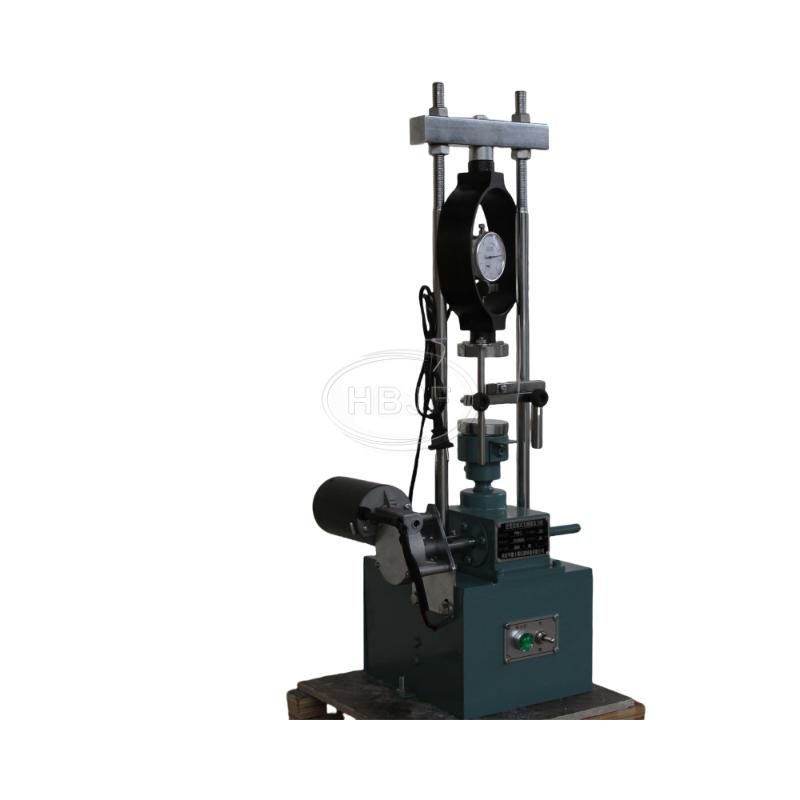
The subgrade forms the foundation of every pavement structure. If it lacks sufficient strength, problems such as settlement, rutting, cracking, and premature pavement failure may occur.
Assessing bearing capacity helps engineers:
Accurate soil strength data ensures pavement layers are neither overdesigned nor underdesigned.
Field testing confirms that compaction meets project specifications before paving begins.
A properly evaluated and prepared subgrade extends pavement service life and minimizes future repairs.
The DCP quickly detects localized soft spots that require stabilization or replacement.
The Dynamic Cone Penetrometer operates using a simple but effective principle.
The steel cone is placed vertically on the soil surface at the selected testing location.
A standardized hammer of known weight is repeatedly dropped from a fixed height onto the anvil.
Each impact drives the cone further into the soil.
After every blow—or a specified number of blows—the penetration depth is recorded.
The penetration rate is usually expressed as:
· Millimeters per blow (mm/blow)
Lower penetration per blow indicates stronger soil, while greater penetration suggests weaker material.
Using established empirical correlations, engineers convert DCP penetration values into estimated engineering properties such as:
· California Bearing Ratio (CBR)
· Shear strength
· Resilient modulus
· Relative compaction
These values help determine whether the subgrade satisfies design requirements.
One of the greatest advantages of the Dynamic Cone Penetrometer is its ability to estimate CBR values quickly.
Traditional CBR testing requires laboratory preparation, soaking, and loading procedures that may take several days.
By contrast, DCP testing provides immediate field data that can be correlated with CBR using accepted engineering relationships.
This makes the Dynamic Cone Penetrometer particularly valuable for:
Evaluate compacted subgrade before paving operations.
Identify weak pavement sections requiring repair.
Assess foundation strength across large areas efficiently.
Provide economical testing where laboratory facilities are limited.
The Dynamic Cone Penetrometer has become one of the most widely used pieces of Soil Test Equipment because of its practical benefits.
A complete test usually takes only a few minutes, allowing engineers to evaluate multiple locations in a single day.
Its lightweight construction makes transportation and field operation simple, even in remote areas.
Minimal equipment requirements and rapid testing reduce overall project costs.
Unlike laboratory methods, DCP testing provides real-time information for quick decision-making.
The test leaves only a small penetration hole, making it suitable for quality control during active construction.
The versatility of DCP testing makes it suitable for numerous engineering projects.
Verify subgrade compaction and identify weak areas before pavement placement.
Assess embankment stability and ballast support conditions.
Evaluate runway and taxiway foundation strength.
Monitor compaction quality during fill operations.
Confirm that field compaction meets engineering specifications throughout the project.
Several conditions can influence penetration measurements.
Wet soils generally produce higher penetration rates due to reduced strength.
Granular soils, clays, silts, and stabilized materials respond differently to hammer impacts.
Better-compacted soils exhibit lower penetration per blow.
Large particles may cause localized resistance and should be considered when interpreting results.
Experienced engineers combine DCP data with other Soil Test Equipment results to obtain a comprehensive understanding of site conditions.
Although the Dynamic Cone Penetrometer is highly effective, it is often used alongside other tests for complete geotechnical evaluation.
Determines maximum dry density and optimum moisture content for field compaction.
Measures bearing capacity under controlled laboratory conditions.
Evaluates deformation characteristics of the soil under applied loads.
Confirms that in-place compaction meets project requirements.
Combining these methods improves design accuracy and construction quality.
Reliable testing depends on precision instruments that deliver consistent and repeatable results. HBJF offers a comprehensive range of Soil Test Equipment for geotechnical laboratories, contractors, universities, and highway engineering departments.
Key advantages include:
HBJF equipment is manufactured to provide dependable and repeatable testing performance.
Products are designed to meet widely recognized ASTM, AASHTO, ISO, and other industry testing specifications.
Robust materials ensure long service life in demanding field and laboratory environments.
User-friendly designs improve testing efficiency while reducing operator fatigue.
In addition to Dynamic Cone Penetrometers, HBJF supplies equipment for soil mechanics, asphalt, concrete, cement, aggregate, and materials testing, allowing customers to build fully equipped laboratories from a single trusted supplier.
The Dynamic Cone Penetrometer is an essential tool for quickly assessing subgrade bearing capacity in the field. By measuring soil penetration resistance and estimating parameters such as CBR, it enables engineers to evaluate soil strength efficiently, identify weak areas, and maintain high construction quality.
As a key component of professional Soil Test Equipment, the DCP helps reduce testing time, improve project efficiency, and support long-lasting pavement performance. With reliable and precision-engineered solutions from HBJF, engineers can perform accurate subgrade assessments with confidence, ensuring infrastructure projects are built on a solid and dependable foundation.
Previous: Intelligent Sulfide Solid-State Electrolyte Production Line Enabled by Bead Grinding Machine
Copyright:@2020-2021

Comments Please sign in or sign up to post.
0
0 of 500 characters used