
Designing a durable pavement begins with understanding the strength and deformation characteristics of the subgrade. Engineers commonly use the California Bearing Ratio (CBR) test to evaluate soil bearing capacity, but there are situations where laboratory CBR results may not accurately represent actual field conditions. In these cases, a Plate Bearing Test (PBT) offers a more direct assessment of in-situ soil performance.
As an important part of modern Soil Test Equipment, both the Plate Bearing Test and the CBR test provide valuable information, but they serve different purposes. Knowing when to replace or supplement laboratory CBR testing with a Plate Bearing Test helps engineers optimize pavement design, reduce construction risks, and improve long-term performance.
In this article, we explore the differences between these two methods, their applications, and why HBJF provides reliable Soil Test Equipment for professional pavement evaluation.
The California Bearing Ratio (CBR) test is one of the most widely used laboratory methods for evaluating subgrade strength.
It compares the penetration resistance of a compacted soil sample with that of a standard crushed stone material.
The resulting CBR value is used to:
· Design flexible pavement thickness
· Classify subgrade quality
· Compare different soil materials
· Support road and airport engineering projects
Because the test is performed under controlled laboratory conditions, it provides standardized and repeatable results.
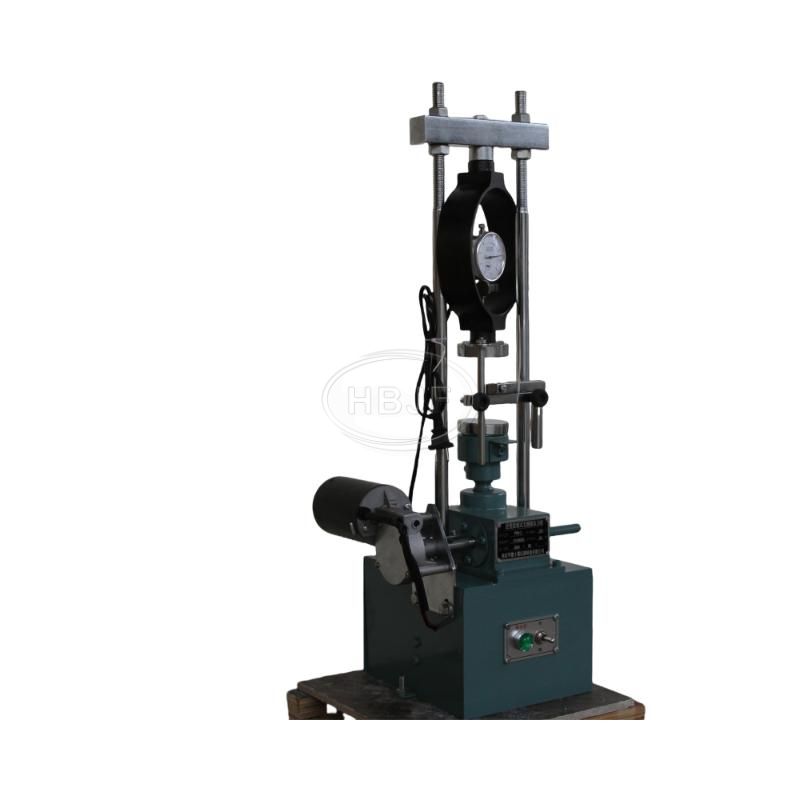
A Plate Bearing Test measures the load-bearing capacity and deformation characteristics of soil directly in the field.
Instead of testing prepared soil samples, a rigid steel plate is placed on the ground surface, and loads are applied incrementally using a hydraulic jack.
The resulting settlement under each load increment is carefully measured.
This method evaluates the actual behavior of the in-place soil, including the effects of compaction, moisture, and existing site conditions.
The testing procedure typically includes several steps.
The testing location is leveled and cleaned to ensure proper contact between the loading plate and the ground.
A steel plate of standard diameter is placed on the prepared surface.
Different plate sizes may be selected depending on project requirements.
A hydraulic loading system gradually increases the applied pressure.
Each load stage is maintained until settlement stabilizes.
Dial gauges or digital displacement sensors record the vertical movement of the plate.
The relationship between load and settlement is plotted for analysis.
Engineers calculate parameters such as:
· Modulus of subgrade reaction (k-value)
· Elastic deformation
· Bearing capacity
· Settlement characteristics
These values are directly applicable to pavement design.
Although both tests evaluate soil performance, their objectives differ.
The laboratory CBR test:
· Uses compacted soil samples
· Measures penetration resistance
· Supports flexible pavement design
· Requires sample preparation
· Produces standardized laboratory values
The Plate Bearing Test:
· Evaluates in-situ soil conditions
· Measures load versus settlement
· Determines deformation behavior
· Reflects actual field performance
· Supports both flexible and rigid pavement design
The Plate Bearing Test often provides more representative information when field conditions differ significantly from laboratory assumptions.
Several situations make the Plate Bearing Test the preferred option.
Major highways, airports, ports, and industrial facilities require highly accurate field data.
A Plate Bearing Test evaluates the subgrade under actual site conditions, reducing uncertainty in design.
Natural soils often vary significantly across a construction site.
A laboratory sample may not represent the entire project area.
Field testing captures these variations more effectively.
Gravelly soils and coarse aggregates are often difficult to test accurately using conventional laboratory CBR procedures.
A Plate Bearing Test is generally more suitable for these materials.
When rehabilitating roads, engineers need to assess the current support capacity of the in-place foundation.
Since laboratory sampling may disturb the soil structure, field testing provides more realistic results.
The Plate Bearing Test verifies whether the completed subgrade performs as expected after compaction.
It offers immediate confirmation before paving operations continue.
The Plate Bearing Test provides several important benefits.
The test evaluates the actual subgrade without relying on reconstructed laboratory samples.
It accounts for natural moisture content, compaction quality, and existing stress conditions.
Engineers receive valuable field information without waiting for laboratory processing.
The method supports both flexible and rigid pavement design.
The measured settlement characteristics improve confidence in engineering decisions.
Although laboratory CBR testing remains an industry standard, it has certain limitations.
Removing and preparing soil samples may alter their natural structure.
Controlled testing cannot fully reproduce field moisture, stress, and loading conditions.
Sample compaction, soaking, and testing require considerable laboratory time.
One laboratory sample may not reflect the variability across an entire construction site.
For these reasons, many engineers use Plate Bearing Tests to supplement or verify laboratory CBR data.
Rather than viewing the two methods as competitors, many successful projects use both together.
A typical workflow includes:
Use laboratory CBR tests to classify soil and estimate pavement thickness.
Perform Plate Bearing Tests after compaction to verify actual subgrade performance.
Compare laboratory and field data to refine pavement thickness and improve long-term durability.
Using multiple testing methods reduces uncertainty and improves engineering confidence.
Accurate pavement evaluation depends on dependable Soil Test Equipment.
Professional laboratories and field engineers typically require:
· CBR testing machines
· Proctor compaction equipment
· Moisture testing devices
· Soil classification tools
· Plate Bearing Test apparatus
· Hydraulic loading systems
· Reaction frames
· Settlement gauges
· Digital data acquisition systems
High-quality instruments ensure consistent and repeatable results throughout every stage of construction.
HBJF supplies a comprehensive range of Soil Test Equipment for geotechnical laboratories, universities, construction companies, and highway engineering organizations.
Key advantages include:
HBJF equipment delivers accurate measurements for both laboratory and field applications.
Products are designed to meet ASTM, AASHTO, ISO, BS, and other internationally recognized testing standards.
Durable materials ensure reliable performance in demanding construction environments.
User-friendly equipment improves testing efficiency while minimizing operator error.
From Plate Bearing Test systems and CBR machines to Proctor compaction equipment and soil classification instruments, HBJF provides complete solutions for geotechnical and pavement testing.
While the laboratory CBR test remains a valuable tool for pavement design, it cannot always represent real field conditions. In projects involving variable soils, large infrastructure developments, coarse-grained materials, or existing pavement evaluations, a Plate Bearing Test offers a more realistic assessment of in-situ bearing capacity and settlement behavior.
Using reliable Soil Test Equipment is essential for obtaining accurate data and making informed engineering decisions. With advanced testing solutions from HBJF, engineers can confidently perform both laboratory and field evaluations, ensuring stronger subgrades, optimized pavement designs, and longer-lasting infrastructure.
Previous: None.
Next: What to do if the robotic welding machine stops when welding
Copyright:@2020-2021

Comments Please sign in or sign up to post.
0
0 of 500 characters used