
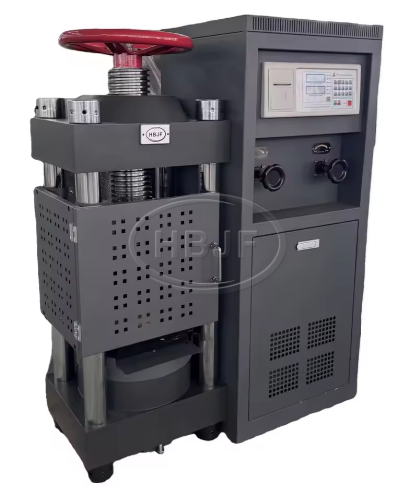
Selecting the correct load capacity is one of the most important decisions when purchasing Compression Testing Machines for concrete testing laboratories. An undersized machine may not safely complete high-strength concrete tests, while an oversized machine can increase equipment costs without providing additional value.
For laboratories testing standard 150mm concrete cubes, understanding the relationship between specimen size, expected compressive strength, and testing standards is essential. In this guide, we'll explain how to calculate the required load capacity, compare common machine capacities, and help you choose the right solution. HBJF offers a complete range of Compression Testing Machines designed to meet international standards and provide accurate, repeatable results for concrete quality control.
A compression testing machine must generate sufficient force to break the concrete specimen while maintaining high measurement accuracy throughout the test.
Choosing the correct load capacity helps laboratories:
· Ensure accurate compressive strength measurements
· Protect the testing machine from overload
· Comply with ASTM, EN, and ISO testing standards
· Improve testing efficiency
· Extend equipment service life
For 150mm concrete cubes, selecting the appropriate capacity depends on the maximum concrete strength expected during testing.
A standard concrete cube has dimensions of:
· Length: 150 mm
· Width: 150 mm
· Height: 150 mm
Its loaded surface area is:
150 mm × 150 mm = 22,500 mm²
Compression testing measures the maximum force applied before failure and converts that force into compressive strength.
The basic calculation is:
Compressive Strength (MPa) = Load (N) ÷ Loaded Area (mm²)
Knowing the specimen area allows laboratories to estimate the machine capacity required for different concrete strength grades.
Modern construction projects use concrete with varying compressive strengths.
Common grades include:
· 20 MPa
· 25 MPa
Typically used for residential foundations and non-structural applications.
· 30 MPa
· 40 MPa
· 50 MPa
Widely used in commercial buildings, bridges, and infrastructure.
· 60 MPa
· 80 MPa
· 100 MPa or higher
Common in high-rise buildings, heavy civil engineering, and specialized structures.
The stronger the concrete, the greater the testing force required.
The required testing force can be estimated using:
Force = Compressive Strength × Loaded Area
Examples for a 150mm cube include:
30 N/mm² × 22,500 mm²
= 675,000 N (675 kN)
50 N/mm² × 22,500 mm²
= 1,125,000 N (1,125 kN)
80 N/mm² × 22,500 mm²
= 1,800,000 N (1,800 kN)
100 N/mm² × 22,500 mm²
= 2,250,000 N (2,250 kN)
These calculations demonstrate why the maximum expected concrete strength must be considered before selecting a testing machine.
Manufacturers typically offer several standard capacities.
Suitable for:
· Low-strength concrete
· Cement mortar specimens
· Educational laboratories
Not recommended for high-strength structural concrete.
The most popular choice for concrete laboratories.
Ideal for:
· 150mm concrete cubes
· Standard structural concrete
· Routine quality control
· Most commercial construction projects
This capacity provides an excellent balance between versatility and cost.
Recommended for:
· High-strength concrete
· Research laboratories
· Infrastructure projects
· Specialized engineering applications
The higher capacity provides additional safety margins for demanding tests.
HBJF offers Compression Testing Machines across multiple load ranges to accommodate various testing requirements.
For laboratories testing concrete strengths between 20 MPa and 60 MPa, a 2000 kN Compression Testing Machine is generally the preferred option.
Benefits include:
· Adequate safety margin
· High measurement accuracy
· Broad application range
· Compliance with international testing standards
When testing concrete above 80 MPa, laboratories should consider a 3000 kN machine.
Advantages include:
· Greater reserve capacity
· Improved long-term durability
· Reduced mechanical stress
· Better suitability for future testing requirements
Choosing a machine with sufficient reserve capacity also helps extend equipment lifespan.
Load capacity is important, but it is not the only specification that affects performance.
Select machines with high-precision load measurement systems to ensure reliable results across the full measuring range.
A rigid frame minimizes deformation during testing and improves repeatability.
Loading platens should fully support standard 150mm concrete cubes while maintaining proper alignment.
International standards require controlled loading speeds. Digital control systems help maintain consistent loading throughout the test.
Modern Compression Testing Machines often include:
· Automatic test execution
· Digital data recording
· Test report generation
· Laboratory management integration
These features improve productivity and reduce operator errors.
HBJF manufactures advanced Compression Testing Machines for construction laboratories, universities, quality inspection agencies, and research institutions worldwide.
HBJF provides machines ranging from laboratory-scale models to heavy-duty systems capable of testing high-strength concrete specimens.
Advanced load cells and digital controllers ensure accurate and repeatable force measurement.
Heavy-duty steel frames maintain stability even under continuous high-load testing.
HBJF equipment is designed to support testing in accordance with EN 12390, ASTM, ISO, and other recognized standards, helping laboratories maintain reliable and compliant testing procedures.
Digital interfaces, automatic testing programs, and intuitive software simplify daily operation while improving efficiency.
To achieve reliable results, laboratories should also follow these recommendations:
· Calibrate Compression Testing Machines regularly.
· Inspect loading platens for wear and alignment.
· Prepare concrete cubes according to applicable standards.
· Apply load at the specified loading rate.
· Keep maintenance and calibration records up to date.
· Train operators in proper testing procedures.
Following these practices helps ensure consistent and repeatable test results throughout the machine's service life.
For standard 150mm concrete cube compression testing, the required machine capacity depends on the expected compressive strength of the concrete. While 1000 kN machines may be suitable for lower-strength materials, 2000 kN Compression Testing Machines are the industry standard for most structural concrete applications. Laboratories working with high-strength concrete or conducting advanced research should consider 3000 kN systems for additional capacity and long-term reliability.
By choosing the appropriate equipment from HBJF, laboratories can achieve accurate testing, comply with international standards, improve operational efficiency, and ensure dependable quality control across every concrete compression test.
Copyright:@2020-2021

Comments Please sign in or sign up to post.
0
0 of 500 characters used