
High-quality aggregates are the foundation of durable roads, highways, airports, and other transportation infrastructure. Whether constructing a road base or designing an asphalt mixture, engineers must verify that aggregates meet strict quality standards before they are incorporated into a project. Mandatory laboratory tests help ensure that aggregates possess the strength, durability, shape, and grading necessary for long-term performance.
Professional Aggregate Testing Equipment plays a vital role in these evaluations, enabling laboratories to perform accurate, repeatable, and standards-compliant tests. In this article, we'll explore the essential aggregate tests commonly required for road base and asphalt mix design and explain why HBJF provides reliable testing solutions for construction laboratories worldwide.
Aggregates account for the majority of pavement volume and significantly influence the structural performance of both road bases and asphalt mixtures.
Proper testing helps engineers:
· Select suitable aggregate sources
· Verify compliance with project specifications
· Improve pavement durability
· Reduce maintenance costs
· Prevent premature pavement failures
Without reliable Aggregate Testing Equipment, it would be impossible to accurately evaluate aggregate quality before construction begins.
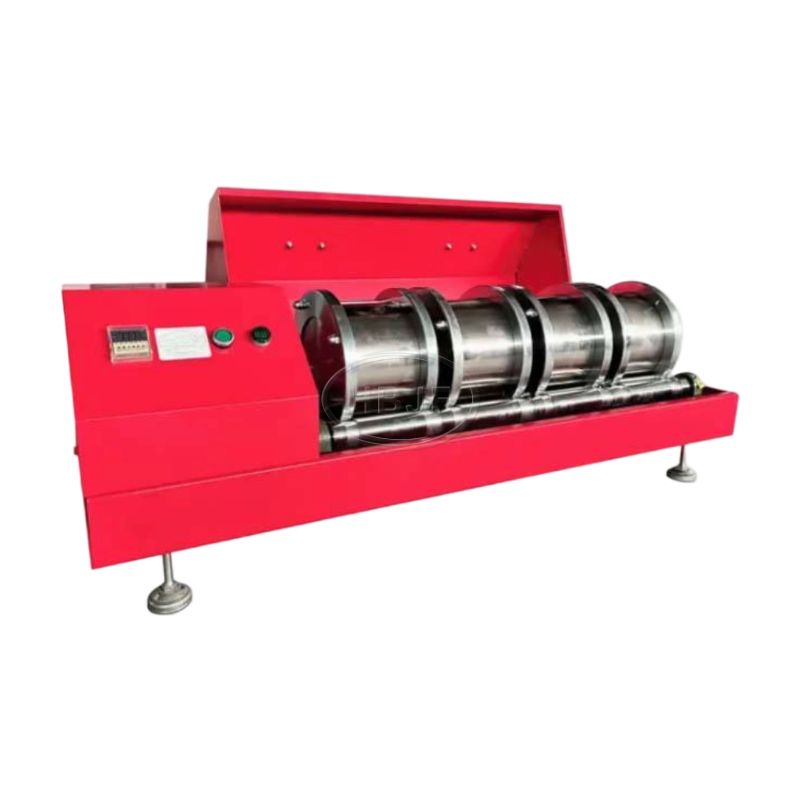
Gradation is one of the first and most important tests performed during aggregate quality control.
Sieve analysis determines the particle size distribution of coarse and fine aggregates.
Proper gradation ensures:
· Good compaction
· Adequate load distribution
· Reduced void content
· Improved asphalt binder efficiency
· Better pavement stability
Typical Aggregate Testing Equipment includes:
· Test sieves
· Mechanical sieve shaker
· Balance
· Drying oven
Gradation requirements vary depending on local standards such as ASTM, AASHTO, or EN specifications.
The LA Abrasion Test measures aggregate resistance to impact and mechanical wear.
Road aggregates are constantly subjected to heavy traffic loads.
Weak aggregates break down over time, causing:
· Rutting
· Surface deterioration
· Loose particles
· Reduced pavement life
Lower LA Abrasion values generally indicate stronger and more durable aggregates.
The test is widely required for:
· Road base materials
· Asphalt mixtures
· Concrete aggregates
· Highway construction
Professional Aggregate Testing Equipment ensures accurate rotation speed and standardized testing conditions.
Many transportation agencies now require the Micro-Deval Test in addition to the LA Abrasion Test.
The Micro-Deval Test evaluates aggregate resistance to abrasion under wet conditions.
Unlike the LA Abrasion Test, water is added during testing, providing a more realistic simulation of field environments.
The test helps assess:
· Wet abrasion resistance
· Long-term pavement durability
· Aggregate performance in humid climates
· Resistance to moisture-related degradation
It has become increasingly important for asphalt pavement design.
The Aggregate Crushing Value Test evaluates the resistance of aggregates to compressive loading.
Road base materials must support heavy traffic without excessive crushing.
A low crushing value indicates:
· High compressive strength
· Better structural support
· Longer pavement service life
The ACV Test is commonly specified for:
· Base courses
· Sub-base layers
· Highway construction
· Heavy-duty industrial pavements
Aggregate particle shape significantly affects pavement performance.
Flat or elongated particles tend to:
· Break more easily
· Reduce compaction efficiency
· Increase void content
· Lower pavement stability
This test measures the percentage of flaky and elongated particles within an aggregate sample.
Most highway agencies limit these particles to ensure better pavement strength and durability.
These properties are essential during asphalt mix design.
Specific gravity is used to calculate:
· Aggregate volume
· Asphalt binder content
· Air voids
· Pavement density
Accurate measurements improve asphalt mixture design precision.
Water absorption indicates aggregate porosity.
Highly porous aggregates may absorb excessive asphalt binder, affecting both performance and project cost.
Reliable Aggregate Testing Equipment helps laboratories obtain precise measurements.
Clean aggregates are critical for durable asphalt mixtures.
The Sand Equivalent Test measures the amount of clay-like materials present in fine aggregates.
High clay content can:
· Reduce asphalt bonding
· Increase moisture susceptibility
· Lower pavement durability
Many road specifications establish minimum sand equivalent values for asphalt aggregates.
In regions with freezing temperatures, aggregate durability against weathering is particularly important.
Aggregates repeatedly exposed to freezing and thawing cycles can deteriorate rapidly.
The Soundness Test evaluates resistance to:
· Freeze-thaw damage
· Salt weathering
· Long-term environmental exposure
This test is commonly required for highway and bridge construction.
Accurate moisture determination is essential before aggregate batching.
Moisture testing allows engineers to:
· Adjust asphalt binder content
· Improve batching accuracy
· Prevent production inconsistencies
· Enhance pavement quality
Moisture measurements are performed routinely in asphalt production plants.
The exact testing requirements vary depending on national standards and project specifications. However, most road base and asphalt mix design projects require a combination of the following:
· Aggregate gradation
· LA Abrasion Test
· Aggregate Crushing Value
· Flakiness and Elongation Index
· Specific Gravity
· Water Absorption
· Moisture Content
· Aggregate gradation
· LA Abrasion Test
· Micro-Deval Test
· Sand Equivalent Test
· Specific Gravity
· Water Absorption
· Soundness Test
· Moisture Content
Many transportation authorities require additional tests based on local climate, traffic conditions, and aggregate source.
Laboratories should select equipment that provides consistent, standards-compliant performance.
Important considerations include:
Equipment should comply with ASTM, AASHTO, EN, or other applicable testing standards.
Accurate measurements ensure reliable quality control and consistent laboratory results.
Digital controls, automatic timers, and intelligent monitoring systems improve efficiency while reducing operator error.
Heavy-duty construction minimizes maintenance and extends equipment service life.
Manufacturers should provide calibration services, spare parts, operator training, and after-sales support.
HBJF is a trusted manufacturer of professional Aggregate Testing Equipment, supplying advanced laboratory solutions for construction companies, universities, research institutes, and quality control organizations.
HBJF offers equipment for virtually every aggregate testing requirement, including:
· Sieve Shakers
· LA Abrasion Testing Machines
· Micro-Deval Testing Machines
· Aggregate Crushing Value Test Equipment
· Flakiness and Elongation Gauges
· Density and Water Absorption Testing Devices
· Sand Equivalent Test Equipment
· Moisture Testing Instruments
HBJF equipment is designed to deliver precise and repeatable results that comply with international testing standards.
Industrial-grade components ensure reliable performance even in high-volume laboratories.
User-friendly interfaces and digital controls simplify testing procedures and improve laboratory productivity.
HBJF provides technical consultation, installation assistance, calibration guidance, and responsive after-sales service to help laboratories maintain testing accuracy.
To achieve dependable testing results:
· Use representative aggregate samples.
· Calibrate equipment regularly.
· Follow standardized testing procedures.
· Inspect testing equipment for wear.
· Maintain complete laboratory records.
· Train technicians in proper operating methods.
Following these best practices improves both testing consistency and overall pavement quality.
Aggregate testing is a critical step in road base construction and asphalt mix design. Mandatory evaluations such as gradation analysis, LA Abrasion, Micro-Deval, Aggregate Crushing Value, particle shape, specific gravity, water absorption, and sand equivalent testing ensure that aggregates meet the performance requirements for durable infrastructure.
Investing in high-quality Aggregate Testing Equipment enables laboratories to produce accurate, repeatable, and standards-compliant results that support better engineering decisions. With its comprehensive product portfolio, precision manufacturing, and commitment to quality, HBJF provides reliable aggregate testing solutions that help engineers and contractors build safer, stronger, and longer-lasting roads.
Copyright:@2020-2021

Comments Please sign in or sign up to post.
0
0 of 500 characters used