
Energy efficiency and water conservation have become major considerations when investing in commercial and industrial ice-making equipment. Whether supplying ice for food processing, seafood preservation, beverage production, or cold chain logistics, businesses want machines that deliver high output while minimizing operating costs. One of the most common comparisons is between the Tube Ice Machine and the cube ice machine.
Although both produce high-quality ice, they differ significantly in production methods, energy consumption, water usage, and application scenarios. This guide compares the two technologies on a per-ton basis to help buyers choose the most cost-effective solution. It also explains why Daxtro manufactures energy-efficient ice machines designed for long-term reliability and performance.
Operating an ice machine involves continuous refrigeration, water circulation, and mechanical operation. Over the lifetime of the equipment, electricity and water costs can exceed the initial purchase price.
Selecting an efficient machine offers several benefits:
· Lower operating costs
· Reduced environmental impact
· Higher production efficiency
· Improved return on investment
· Better sustainability performance
For businesses producing several tons of ice each day, even small improvements in efficiency can generate significant annual savings.
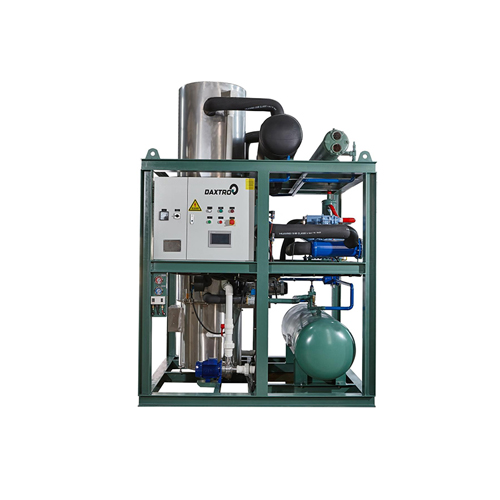
Before comparing consumption figures, it is important to understand how each machine produces ice.
Cube ice machines freeze water inside individual molds or evaporator plates. Once the cubes reach the desired thickness, a hot gas or water-assisted harvesting cycle releases the ice into the storage bin.
Cube ice is known for:
· Crystal-clear appearance
· High density
· Slow melting
· Premium beverage presentation
These machines are commonly found in:
· Hotels
· Restaurants
· Bars
· Cafés
· Supermarkets
A Tube Ice Machine freezes water around vertical evaporator tubes, forming hollow cylinders. Once the ice reaches the required thickness, it is cut into uniform tube-shaped pieces.
Tube ice offers:
· Hollow cylindrical shape
· High production capacity
· Excellent cooling efficiency
· Easy storage and transportation
It is widely used in:
· Seafood processing
· Beverage factories
· Food processing plants
· Ice distribution centers
· Industrial cooling
Electricity usage is one of the largest operating expenses for commercial ice production.
Cube ice production requires multiple freezing and harvesting cycles.
Energy is consumed during:
· Water freezing
· Compressor operation
· Harvest heating cycle
· Water circulation
· Control system operation
Because each batch must complete a full production cycle, energy consumption is generally higher per ton than continuous ice-making systems.
Cube ice machines prioritize ice clarity and appearance rather than maximum production efficiency.
A modern Tube Ice Machine operates with a more continuous production process.
Its refrigeration system is optimized for high-volume industrial output.
Advantages include:
· Continuous ice formation
· Reduced harvesting energy
· Stable compressor operation
· Higher production efficiency
As a result, many industrial tube ice machines consume less electricity per ton of ice produced, particularly in medium- and large-capacity installations.
Water efficiency is equally important, especially in regions with limited water resources.
Cube ice machines often require additional water during harvesting and cleaning cycles.
Water may also be discharged to remove mineral buildup and maintain ice clarity.
Water consumption depends on:
· Water quality
· Machine design
· Purge cycle frequency
· Operating conditions
Modern premium machines have significantly improved water-saving technologies, but water usage can still be relatively higher.
Most Tube Ice Machines recycle circulating water during ice formation.
Their continuous freezing process generally produces less wastewater than batch-style cube ice systems.
Additional benefits include:
· Higher water utilization
· Reduced water discharge
· Lower operating costs
· Improved sustainability
This makes tube ice production particularly attractive for large industrial operations.
Production efficiency affects both operating costs and equipment utilization.
Cube ice machines are optimized for beverage-quality ice.
They emphasize:
· Crystal clarity
· Uniform cube size
· Attractive appearance
· Food-grade hygiene
Production speed is typically lower because each batch requires sufficient freezing time.
A Tube Ice Machine is designed for continuous industrial production.
Advantages include:
· Large daily output
· Short production cycles
· High operational efficiency
· Continuous harvesting
Many industrial models can produce several tons of ice per day while maintaining consistent quality.
Long-term operating expenses extend beyond electricity and water.
Maintenance typically includes:
· Cleaning evaporator plates
· Replacing water filters
· Descaling water systems
· Sanitizing ice bins
Because appearance is critical, water treatment often requires greater attention.
Industrial Tube Ice Machines feature robust mechanical designs intended for continuous operation.
Routine maintenance generally includes:
· Refrigeration inspection
· Water circulation checks
· Cutter maintenance
· Condenser cleaning
Industrial-grade components contribute to lower maintenance frequency in high-volume applications.
The best choice depends on your operational priorities.
· Premium beverage presentation
· Hotels and resorts
· Cocktail bars
· Restaurants
· Coffee shops
· Hospitality businesses
Cube ice delivers excellent visual appeal and slow melting, enhancing the customer experience.
· Large-scale ice production
· Food processing
· Seafood preservation
· Beverage manufacturing
· Ice distribution
· Industrial cooling
A Tube Ice Machine provides superior production efficiency, lower operating costs, and easier bulk handling.
Actual consumption varies depending on several operating conditions.
Higher room temperatures increase refrigeration workload and electricity usage.
Cooler inlet water reduces freezing time and improves energy efficiency.
Large industrial machines often achieve better energy efficiency per ton due to optimized refrigeration systems.
Dirty condensers, blocked filters, and poor water quality increase power consumption and reduce production efficiency.
Regular preventive maintenance helps maintain optimal performance.
Daxtro manufactures advanced Tube Ice Machines that combine high production capacity with outstanding energy and water efficiency.
Optimized refrigeration systems reduce power consumption while maintaining stable ice production.
Daxtro machines feature smart automation, including:
· Automatic operation
· Real-time performance monitoring
· Fault diagnostics
· Automatic protection systems
· User-friendly touch-screen interfaces
Advanced water circulation systems maximize water utilization while minimizing waste.
Food-grade stainless steel construction and premium refrigeration components ensure long service life under demanding industrial conditions.
Daxtro offers Tube Ice Machines in a wide range of capacities suitable for:
· Food factories
· Fisheries
· Beverage plants
· Chemical industries
· Cold storage facilities
· Commercial ice suppliers
This flexibility allows businesses to choose the most efficient solution for their production requirements.
Regardless of machine type, businesses can improve efficiency by:
· Installing water filtration systems.
· Cleaning condensers regularly.
· Maintaining proper ventilation around the equipment.
· Monitoring refrigerant performance.
· Performing preventive maintenance.
· Using the machine within its recommended operating conditions.
These practices help maximize both energy efficiency and equipment lifespan.
Both cube ice machines and Tube Ice Machines serve important roles in commercial and industrial applications, but they are designed for different priorities. Cube ice machines excel in beverage service, producing dense, crystal-clear ice that melts slowly and enhances drink presentation. In contrast, Tube Ice Machines are engineered for high-volume production, offering superior energy efficiency, lower water consumption, and reduced operating costs per ton of ice in many industrial environments.
For businesses focused on large-scale ice production and long-term operational savings, Daxtro Tube Ice Machines provide an ideal combination of efficiency, durability, and intelligent automation. By investing in advanced ice-making technology, companies can improve productivity, reduce resource consumption, and achieve a more sustainable and cost-effective operation.
Previous: How Color Sorter Machines Work: Fundamental Principles
Next: Shape, Density, and Melting Speed Differences Between Cube and Tube Ice
Copyright:@2020-2021

Comments Please sign in or sign up to post.
0
0 of 500 characters used