
Non skid and anti slip tapes are practical safety products designed to improve traction on surfaces where slipping could cause accidents, equipment damage, or operational disruption. We use these tapes across industrial facilities, commercial buildings, transportation areas, warehouses, workshops, stairways, ramps, and residential environments where additional surface grip is required.
Although the terms non skid tape and anti slip tape are often used interchangeably, different products offer different levels of traction, durability, adhesion, weather resistance, and chemical resistance. Understanding these differences allows us to select the right tape for a specific environment instead of treating every application as the same.
Non skid tape is a pressure-sensitive safety tape with a textured surface that increases friction between footwear, wheels, equipment, or other objects and the underlying surface. The abrasive layer typically contains mineral particles or other traction-enhancing materials.
When installed correctly, the tape creates a rougher contact surface. This additional friction helps reduce the likelihood of slipping, particularly in areas exposed to moisture, dust, oil, grease, or frequent foot traffic.
We commonly use non skid tape on:
Industrial stairs and steps
Loading platforms
Ramps and walkways
Factory floors
Ladders
Machine access areas
Warehouse platforms
Vehicle steps
Boat decks
Commercial entrances
Outdoor pedestrian areas
The appropriate product depends on the surface, environmental conditions, expected traffic, and required service life.
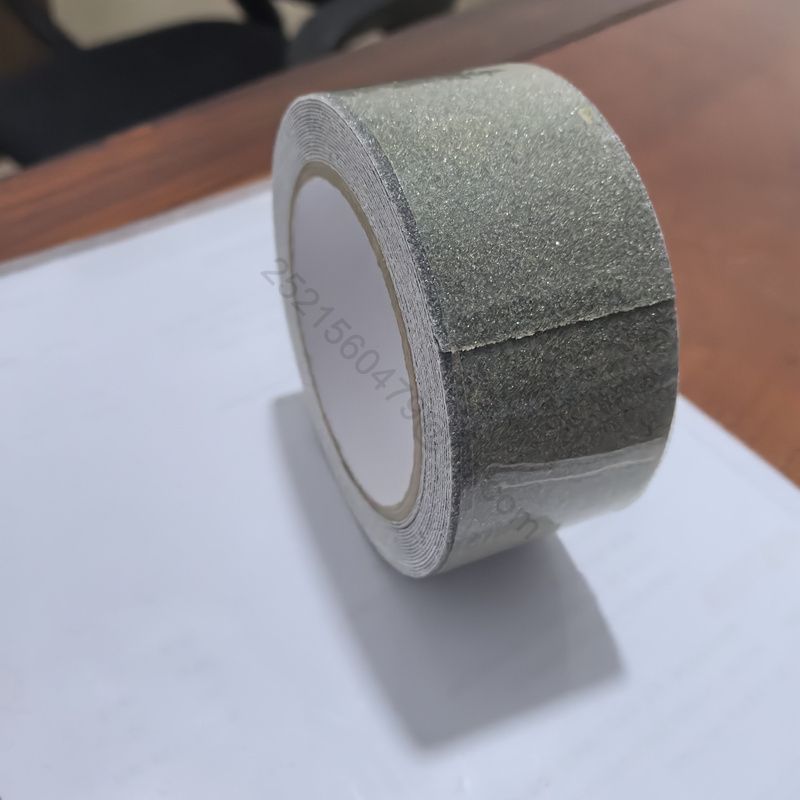
Anti slip tape is a broader category of safety tape designed specifically to increase traction and reduce the risk of slips. It generally combines a strong adhesive backing with a high-friction surface.
A typical anti slip tape consists of several functional layers. The backing provides dimensional stability, the adhesive creates the bond with the installation surface, and the exposed abrasive layer provides traction.
Different anti slip tapes can have different abrasive grades. Fine textures are suitable for applications where users require comfortable walking surfaces, while coarse textures are better suited to demanding industrial environments.
For example, a warehouse staircase may require a durable medium-grit product, whereas an industrial platform exposed to oil and heavy contamination may require a much more aggressive abrasive surface.
The difference between non skid and anti slip tapes is primarily related to terminology rather than a completely separate product category.
Non skid tape emphasizes the ability of the surface to resist sliding, while anti slip tape emphasizes its safety function of reducing slip hazards. In commercial and industrial markets, both terms can describe abrasive safety tapes with similar construction.
However, not every product marketed as anti slip tape provides the same performance.
When comparing products, we recommend examining:
Abrasive material
Grit level
Adhesive type
Tape thickness
Backing material
Temperature resistance
Water resistance
Chemical resistance
UV resistance
Expected foot traffic
Surface compatibility
These factors provide more useful information than the product name alone.
Anti slip tape works primarily by increasing the coefficient of friction between the surface and the object contacting it.
A smooth floor can become particularly slippery when contaminated by water, oil, mud, dust, or other substances. The abrasive texture of an anti slip tape creates additional mechanical interaction with footwear or equipment.
The effectiveness of the tape depends on proper installation. A high-quality product can perform poorly if it is applied to a dirty, wet, oily, uneven, or unsuitable surface.
For this reason, surface preparation is one of the most important factors in anti slip tape performance.
Several materials can be used to manufacture the abrasive surface and backing.
Aluminum oxide is widely used because it provides a hard, durable abrasive surface. It is suitable for demanding industrial applications where resistance to repeated traffic is important.
Silicon carbide offers a sharp and aggressive texture. It can be selected for applications requiring high traction and strong resistance to wear.
Various mineral particles can be incorporated into safety tapes to achieve different levels of surface roughness. The specific abrasive selection influences traction, durability, and user comfort.
Polymer-based backings provide flexibility and can be useful when the tape needs to conform to slightly irregular surfaces. Some products are also designed for temporary or less demanding applications.
Grit is one of the most important characteristics when selecting an anti slip tape.
A fine-grit anti slip tape generally provides a smoother walking experience and is appropriate for areas where barefoot contact or frequent pedestrian traffic is expected.
A medium-grit tape offers a balance between traction and comfort. It is commonly suitable for stairs, walkways, workshops, and general commercial applications.
A coarse-grit tape provides aggressive traction for demanding industrial environments. It can be appropriate for heavy-duty platforms, machinery access points, and areas where contamination or difficult working conditions are expected.
The roughest product is not automatically the best product. Excessively aggressive textures can create discomfort, interfere with certain wheeled equipment, or become difficult to clean.
Indoor and outdoor environments impose different requirements on safety tape.
Indoor applications are often protected from direct sunlight and severe weather, but they may still involve oil, grease, chemicals, dust, and heavy foot traffic.
Outdoor applications require additional resistance to rain, UV exposure, temperature fluctuations, and moisture. Outdoor-grade products should maintain adhesive performance and surface integrity under changing environmental conditions.
For outdoor stairs, ramps, walkways, and platforms, we should therefore evaluate both the abrasive surface and adhesive system rather than selecting a tape solely according to its appearance.
Staircases are one of the most common applications for anti slip tape because a loss of footing on a stair can result in a particularly serious fall.
Anti slip strips can be installed near the leading edge of each step to provide a visible and tactile traction zone. The width and placement should be consistent across the staircase.
For industrial stairs, a highly durable abrasive tape may be preferred. For offices and commercial buildings, a medium-grit product may provide sufficient traction without creating an unnecessarily harsh walking surface.
Visibility can also matter. Black and yellow anti slip tape is frequently used in industrial environments because the contrasting colors can make step edges and hazard areas easier to identify.
Proper installation begins with surface preparation.
First, remove dust, dirt, grease, oil, loose coatings, and other contaminants. The surface must be sufficiently dry before installation. Smooth and stable substrates generally provide the best results.
Next, measure and cut the tape to the required dimensions. Avoid stretching the tape during application because excessive tension can contribute to lifting or dimensional instability.
Apply the tape gradually while pressing it firmly against the surface. Particular attention should be paid to the edges because edge lifting can allow moisture and contamination to penetrate beneath the adhesive.
After installation, apply firm pressure across the entire tape area. Depending on the adhesive system and environmental conditions, the product may require a curing or dwell period before being subjected to heavy traffic.
Several factors can influence service life.
Surface condition is critical. Contaminated or unstable surfaces can prevent proper bonding.
Temperature also matters because adhesives have specified operating ranges. Extremely low or high temperatures can affect adhesion and flexibility.
Moisture may become a problem when water reaches the adhesive interface or remains trapped beneath the tape.
Chemical exposure should also be considered in factories, laboratories, workshops, and processing facilities.
Finally, traffic intensity directly affects wear. A tape installed on a lightly used access stairway may last considerably longer than the same product installed in a busy industrial passage.
Anti slip tape is highly versatile, but it should not automatically be applied to every surface.
Loose, damaged, heavily contaminated, peeling, or structurally unstable substrates should be repaired before tape installation. Extremely uneven surfaces may also prevent sufficient adhesive contact.
Applications involving extreme temperatures, aggressive chemicals, continuous immersion, or specialized industrial processes should be evaluated against the manufacturer's technical specifications.
In safety-critical environments, anti slip tape should be considered one component of a broader slip-prevention strategy rather than the sole safety measure.
The main advantage is improved surface traction without the need for major structural modifications.
Other benefits include:
Fast installation
Low installation complexity
Versatile surface applications
Improved pedestrian traction
Clear visual hazard marking
Cost-effective safety improvement
Availability in different widths and colors
Suitable options for indoor and outdoor environments
Compared with permanently modifying a floor or rebuilding a staircase, safety tape can provide a relatively straightforward way to improve traction on an existing surface.
We recommend evaluating the application systematically.
Start by identifying whether the installation is indoor or outdoor. Next, determine the expected traffic level and whether users will walk on the surface, operate equipment, or move wheeled loads.
Then evaluate exposure to water, oil, chemicals, sunlight, and temperature changes. Select the appropriate grit based on the required traction and user comfort.
Finally, verify substrate compatibility and adhesive requirements.
A suitable anti slip tape should provide the right combination of traction, adhesion, durability, environmental resistance, and usability rather than simply offering the roughest available surface.
Non skid and anti slip tapes are practical solutions for improving traction on stairs, ramps, platforms, walkways, machinery access points, and many other potentially slippery surfaces. Although the terms are often used interchangeably, performance can vary significantly depending on abrasive material, grit, adhesive, backing, and environmental resistance.
By considering the installation surface, traffic conditions, exposure factors, required traction, and expected service life, we can select an anti slip tape that delivers reliable performance for its intended application. For more details please visit www.sticktapefactory.com
Previous: Why Do Shipping Labels Wrinkle or Lift on Plastic Mailing Bags?
Next: Custom Shopping Bags for Chain Stores and Retail Expansion
Copyright:@2020-2021

Comments Please sign in or sign up to post.
0
0 of 500 characters used