
FRP H-beams are structural profiles manufactured from fiberglass reinforcement and polymer resin through pultrusion. They combine a high strength-to-weight ratio with corrosion resistance and electrical insulation, making them useful for structures exposed to moisture, chemicals, salt, and other aggressive environments.
For engineers and project buyers, the main advantage of FRP structural profiles is not simply their lower weight. Their corrosion-resistant composite construction can help reduce maintenance requirements in applications where conventional steel structures are repeatedly exposed to harsh conditions.
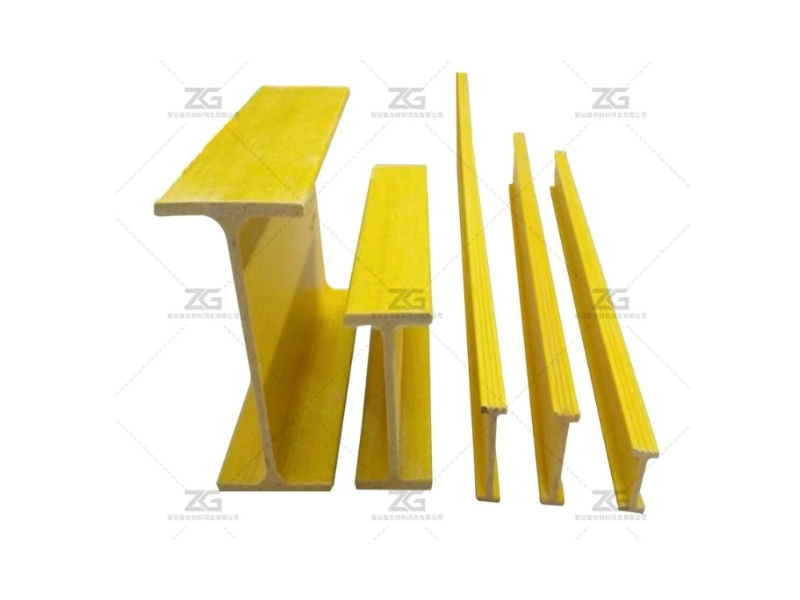
An FRP H-beam is a structural profile made from fiberglass reinforced plastic.
The pultrusion process continuously pulls reinforcing fibers through a resin system and a heated forming die. This produces a consistent profile with a controlled cross-sectional shape.
Zhigu manufactures FRP H-beams using E-glass fiber reinforcement combined with vinyl ester or polyester resin systems.
Typical applications include:
Structural frames
Industrial platforms
Walkways
Equipment supports
Corrosive industrial facilities
Water treatment infrastructure
Chemical facilities
Utility structures
Steel remains widely used for structural applications, but corrosion can become a major consideration when structures are continuously exposed to water, chemicals, salt spray, or high humidity.
FRP provides several material characteristics that can be valuable in these conditions.
FRP does not experience conventional steel rusting.
This makes it suitable for wastewater treatment plants, chemical processing areas, coastal facilities, and other environments where corrosion protection is an ongoing concern.
FRP profiles generally have a lower density than steel.
Lower component weight can simplify transportation and manual handling, particularly for modular structures and maintenance projects.
Unlike conductive metallic profiles, FRP is electrically insulating.
This characteristic can be valuable around electrical equipment, power infrastructure, and facilities where electrical isolation is an important design consideration.
Because FRP does not require the same corrosion-control approach as carbon steel, maintenance requirements can be reduced in suitable environments.
The actual lifecycle benefit depends on installation conditions, structural design, UV exposure, chemical environment, and expected service life.
Pultrusion is a continuous manufacturing process designed to produce profiles with consistent cross-sectional geometry.
The reinforcement arrangement is important because fiberglass carries much of the structural load while the resin matrix binds the fibers together and provides environmental protection.
For buyers, quality evaluation should therefore consider:
Fiber type
Resin system
Fiber content
Profile dimensions
Surface finish
Dimensional tolerance
Mechanical properties
Chemical resistance
UV resistance
Fire performance
Quality-control procedures
These parameters are often more useful than simply comparing the quoted price per meter.
FRP structural profiles can be particularly attractive where corrosion and weight create challenges for conventional materials.
Water treatment facilities often contain wet environments and chemicals. FRP structural profiles can be used for support structures, platforms, and access systems.
Chemical processing environments may expose structural components to corrosive substances. The resin system should be selected according to the specific chemical exposure.
Saltwater and marine atmospheres can accelerate corrosion of metallic structures. FRP can provide an alternative for suitable structural applications.
Electrical insulation is another reason FRP profiles may be considered around certain utility and power applications.
Before purchasing FRP H-beams, buyers should request technical information covering:
Profile dimensions
Resin type
Glass fiber type
Fiber content
Mechanical properties
Surface finish
Dimensional tolerances
Operating temperature
Chemical resistance
UV resistance
Fire performance
Available lengths
Custom profile capability
For structural projects, buyers should also provide span, loading, support conditions, and installation environment so that the profile can be evaluated correctly.
The value of an FRP H-beam comes from the combination of structural performance and material durability.
In environments where steel requires frequent corrosion protection, FRP can provide a different lifecycle approach. Its lightweight characteristics can also simplify handling and installation.
Zhigu's FRP H-beam product uses E-glass fiber with vinyl ester or polyester resin through a pultrusion process and is designed for applications requiring corrosion resistance, electrical insulation, and structural performance.
Copyright:@2020-2021

Comments Please sign in or sign up to post.
0
0 of 500 characters used