
In the fields of precision electronics and sensing, the choice of piezoelectric material is critical for device performance. While various polycrystalline piezoelectric ceramics and alternatives exist on the market, single crystal quartz wafers remain the superior choice for many high-end, high-stability applications. This article explains the key scenarios where single crystal quartz outperforms other piezoelectric materials.
Single crystal quartz (especially with ST-cut or AT-cut) exhibits an extremely low frequency-temperature coefficient. In oscillators, filters, and timing circuits, frequency stability is paramount. Compared to many piezoelectric ceramics (like PZT), quartz shows minimal frequency variation across a wide temperature range (e.g., -40°C to +85°C or higher), maintaining stable output. This makes single crystal quartz the material of choice for clock sources in telecommunications equipment, navigation systems, and high-precision instrumentation.
Quartz crystals possess a very high mechanical quality factor (Q factor), often reaching tens of thousands or more. This results in extremely low energy loss at resonance, providing sharp resonant peaks and very low phase noise. For applications requiring high-selectivity filtering or low-jitter time-base references, such as in RF circuits and precision frequency control, quartz’s high Q value is a decisive advantage over most piezoelectric ceramics, which typically have lower Q factors and higher intrinsic losses.
Aging refers to the gradual change in a crystal’s resonant frequency over time. Single crystal quartz exhibits excellent long-term stability, with very low aging rates (often less than 5 ppm per year for high-quality units). This is due to its stable, defect-free crystalline structure. In contrast, many piezoelectric ceramics can experience more significant aging due to factors like domain wall motion, porosity, and stress relaxation. For applications like frequency standards, metrology, or satellite systems that require decades of reliable operation, quartz’s stability is a key benefit.
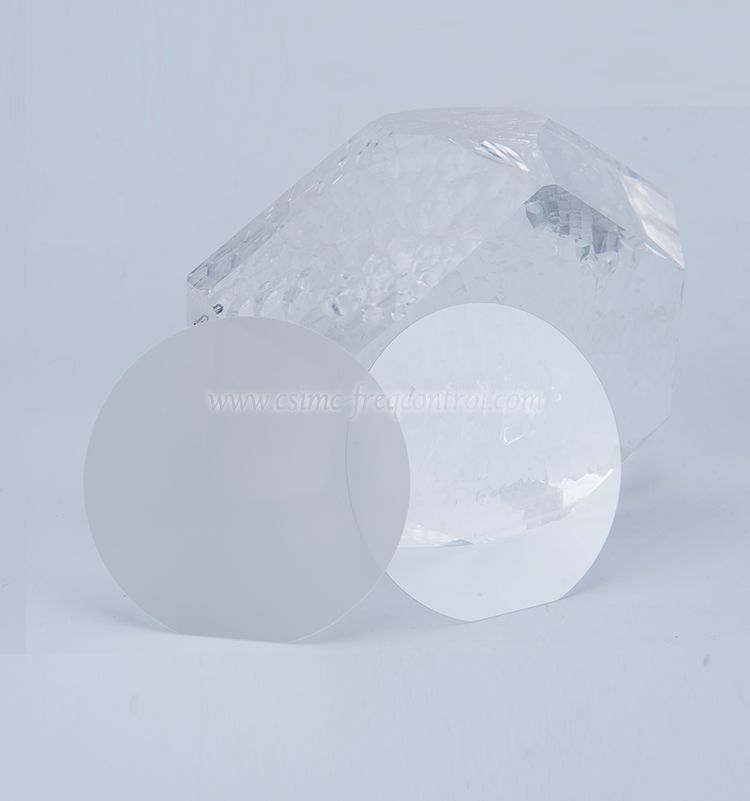
The manufacturing process for single crystal quartz (grown via hydrothermal synthesis) is mature and highly controlled. This results in exceptional consistency in material properties from wafer to wafer and batch to batch. The ability to precisely control the crystal orientation (cut) allows engineers to tailor the temperature and frequency characteristics for specific applications. While advanced piezoelectric ceramics offer design flexibility, their properties can vary more significantly, and their performance can be influenced by factors like poling conditions and electrode materials, introducing additional variables in high-volume production.
Single crystal quartz is inherently robust in harsh environments. It is resistant to most common chemicals, radiation (to a significant degree), and extreme vacuum conditions. Its performance is also less susceptible to high mechanical shock and vibration compared to many brittle piezoelectric ceramics. This makes it a preferred material in aerospace, defense, downhole drilling, and space applications, where reliability under stress is non-negotiable.
For more information please contact CQT
Considering the advantages above, single crystal quartz wafers are strongly preferred in the following applications:
Timing Devices: Real-time clocks (RTCs), crystal oscillators (TCXOs, OCXOs), and microprocessor clock circuits.
Frequency Control: RF filters, duplexers, and resonators in communications infrastructure (4G/5G base stations, satellites).
Sensors: High-precision pressure, force, and acceleration sensors where stability and linearity are critical.
Scientific and Metrology Instruments: Standards for frequency, mass (quartz crystal microbalances), and viscosity measurement.
While piezoelectric ceramics like PZT, lithium niobate, or PMN-PT offer advantages in specific areas—such as higher coupling coefficients for actuators or greater sensitivity in some sensors—single crystal quartz remains unmatched for applications demanding ultimate stability, low loss, and long-term reliability. The choice is not about which material is universally "better," but which is optimal for the specific requirements. For the core tasks of generating, filtering, and measuring time and frequency with unwavering precision, single crystal quartz wafers continue to be the preferred and proven solution.
Copyright:@2020-2021

Comments Please sign in or sign up to post.
0
0 of 500 characters used