
Piezoelectric wafers are critical components in modern electronic and sensing technologies. Among the most widely used materials are Single Crystal Quartz Wafers and lithium-based piezoelectric wafers such as lithium niobate and lithium tantalate. Each material exhibits unique electrical, mechanical, and thermal properties that determine its suitability for different applications.
This article explores the performance differences between quartz and lithium-based piezoelectric wafers, helping engineers and manufacturers choose the right material for devices such as sensors, resonators, filters, and precision timing components.
CQT Single Crystal Quartz Wafers are made from high-purity crystalline quartz grown using specialized crystal growth techniques. The material exhibits excellent piezoelectric behavior and exceptional stability, which makes it a cornerstone in precision electronics.
Key characteristics include:
High frequency stability
Low temperature drift
Excellent long-term reliability
Low acoustic loss
High mechanical quality factor (Q)
Because of these properties, Single Crystal Quartz Wafers are commonly used in:
Crystal oscillators
Timing devices
Frequency control systems
Sensors requiring long-term stability
Quartz’s stable crystal lattice structure allows it to maintain consistent performance even in demanding environments.
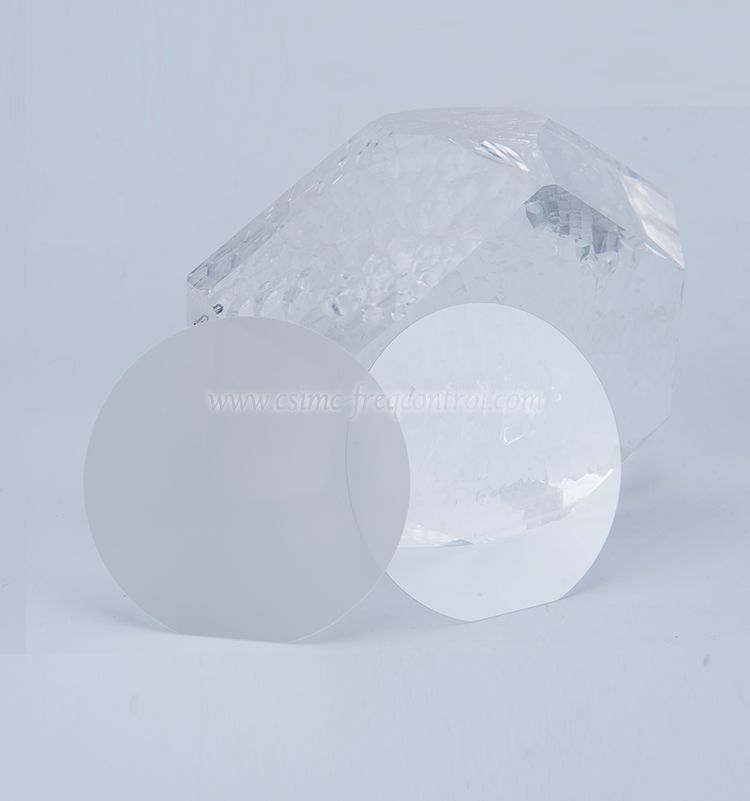
Lithium-based piezoelectric wafers typically refer to materials such as lithium niobate (LiNbO₃) and lithium tantalate (LiTaO₃). These materials have stronger piezoelectric coupling compared with quartz and are widely used in high-frequency electronic applications.
Typical characteristics include:
High electromechanical coupling coefficient
Strong piezoelectric response
Good suitability for high-frequency devices
Excellent performance in surface acoustic wave (SAW) devices
Lithium-based wafers are frequently used in:
RF filters in mobile communications
Surface acoustic wave devices
Optical modulators
High-frequency signal processing components
Their strong coupling efficiency allows for compact device designs and improved signal conversion efficiency.
Although both materials belong to the piezoelectric family, their performance characteristics differ significantly.
Single Crystal Quartz Wafers are well known for outstanding frequency stability. Quartz devices exhibit minimal drift over time and temperature, making them ideal for timing and precision measurement applications.
Lithium-based wafers generally exhibit higher temperature sensitivity and lower long-term stability compared with quartz.
Result:
Quartz is superior for precision frequency control.
Lithium-based materials provide significantly stronger electromechanical coupling than quartz. This allows them to convert electrical signals into mechanical vibrations more efficiently.
Quartz, while stable, has a relatively weaker coupling coefficient.
Result:
Lithium wafers perform better in high-efficiency signal conversion applications.
Quartz crystals can be cut in specific orientations (such as AT-cut or BT-cut) to minimize temperature-induced frequency changes.
Lithium-based materials are more sensitive to temperature variations and often require additional compensation in device design.
Result:
Quartz provides better thermal stability.
Lithium-based wafers support stronger acoustic wave propagation, which makes them highly suitable for SAW and bulk acoustic wave devices used in RF communication systems.
Quartz offers lower acoustic losses but weaker acoustic wave interactions.
Result:
Lithium materials are preferred for RF filters and SAW devices.
Single Crystal Quartz Wafers demonstrate excellent long-term reliability and extremely low aging rates. This means devices maintain consistent performance for many years.
Lithium-based wafers may show slightly higher aging effects depending on environmental conditions and device design.
Result:
Quartz provides better long-term stability.
The different material characteristics lead to distinct application areas.
Applications of Single Crystal Quartz Wafers
Precision oscillators
Timing references
Quartz resonators
High-accuracy sensors
Navigation and aerospace electronics
Applications of Lithium-Based Wafers
RF filters in smartphones
Surface acoustic wave (SAW) devices
Optical modulation systems
High-frequency communication components
In many modern electronics, both materials are used together in complementary roles.
Selecting between quartz and lithium-based wafers depends on the priorities of the device design.
Choose Single Crystal Quartz Wafers when the application requires:
Exceptional frequency stability
Low temperature drift
Long operational lifetime
Precision timing
Choose lithium-based wafers when the application requires:
Strong electromechanical coupling
High-frequency operation
Efficient signal conversion
Advanced RF filtering capabilities
Understanding these trade-offs helps engineers optimize device performance and reliability.
Both quartz and lithium-based piezoelectric wafers play essential roles in modern electronics. However, their performance characteristics differ in several critical areas.
Single Crystal Quartz Wafers excel in stability, reliability, and precision timing, making them indispensable in frequency control technologies. Lithium-based materials, on the other hand, provide stronger piezoelectric coupling and superior performance in high-frequency communication devices.
By understanding the performance differences between these materials, engineers can select the most suitable wafer type for their specific application requirements, ensuring optimal performance and long-term device reliability.
Previous: How Material Properties Impact Frequency Stability in SAW Devices
Next: Key Selection Criteria for Lithium Tantalate Wafers in SAW Devices
Copyright:@2020-2021

Comments Please sign in or sign up to post.
0
0 of 500 characters used