
A wifi smart energy meter is a connected device used to measure electricity consumption and send energy data to a mobile app, cloud platform, or energy management system. Unlike a traditional electricity meter that mainly shows total usage, a smart meter can help users understand when electricity is being used, how much power specific circuits consume, and whether energy usage changes over time.
For homeowners, it can help explain why monthly electricity bills rise. For small businesses, it can support equipment monitoring and cost control. For solar users, it can help compare energy consumption and production. As electricity prices, solar adoption, EV charging, and smart home automation continue to grow, WiFi energy meters are becoming more useful in both residential and light commercial environments.
A WiFi smart energy meter usually measures electrical values such as voltage, current, active power, power factor, frequency, and total energy consumption.
In many systems, current is measured through CT clamps. These sensors clip around electrical conductors and measure current without cutting the wire. The meter then calculates power consumption and sends data through a 2.4GHz WiFi connection to an app or platform.
A typical process looks like this:
The meter measures electrical signals.
CT clamps detect current flow.
The device calculates real-time power and accumulated energy.
Data is transmitted through WiFi.
Users view reports through an app or dashboard.
More advanced meters may also support bidirectional measurement, which is useful for solar systems because users can track both electricity consumption and energy production.
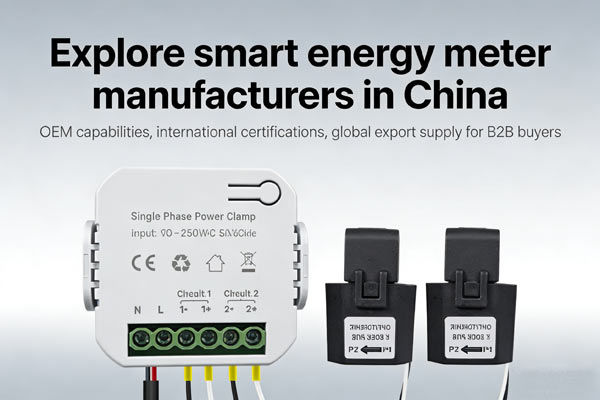
WiFi energy meters are not all the same. The best type depends on the electrical system, installation environment, and monitoring goal.
Single-phase meters are commonly used in apartments, houses, small shops, and individual circuit monitoring. They are suitable when the user wants to track household consumption, a heat pump, an EV charger, or one important load.
Three-phase meters are used in larger homes, commercial buildings, restaurants, workshops, and facilities with higher power demand. A 3 phase wifi clamp energy meter can monitor multiple phases at the same time and provide a clearer picture of total energy usage in three-phase systems.
DIN rail models are installed inside distribution boards or electrical cabinets. A din rail WIFI power meter is often selected for permanent installations because it looks professional, saves panel space, and is easier to manage in electrical enclosures.
Some users do not only want total consumption. They want to know how much power is used by lighting, HVAC, kitchen equipment, EV charging, solar, or other circuits. Multi-circuit systems are designed for this type of detailed energy breakdown.
A WiFi smart energy meter can be used in many different environments.
For homes, it helps users understand daily electricity consumption, peak usage periods, and major energy-consuming appliances.
For solar systems, it helps compare grid import, grid export, and self-consumption.
For commercial buildings, it supports energy cost analysis, equipment monitoring, and operational efficiency.
For restaurants and small facilities, it can help identify equipment that remains powered during non-business hours.
For smart homes, energy data may also be used to trigger automation rules, such as delaying EV charging or turning off non-essential loads when power demand is too high.
Installation depends on the meter type.
CT clamp models are usually installed by placing clamps around the target conductors. DIN rail models are mounted inside an electrical panel. Some meters require voltage reference wiring, while others may include relay or control functions.
General installation steps may include:
Confirming the electrical system type
Selecting the correct CT clamp size
Mounting the meter safely
Connecting voltage and CT inputs
Pairing the device with a mobile app
Checking whether readings are accurate
Electrical installation should always follow local safety codes and should be handled by qualified personnel when required.
After installation, users can review energy data in several ways.
Real-time power readings show what is happening now. Historical reports help users compare usage by hour, day, week, or month. Solar users can check whether generation is being consumed on-site or exported to the grid. Business users can compare operating hours with energy consumption patterns.
The most valuable use is not simply viewing data, but finding patterns. For example, high night-time consumption may indicate standby loads. A sudden increase may suggest equipment issues. Repeated peak demand may show that some appliances should be scheduled differently.
The price depends on several factors:
Single-phase or three-phase design
Number and size of CT clamps
DIN rail or wall-mounted structure
App and cloud platform support
Relay or control function
Solar or bidirectional monitoring capability
Certification and accuracy level
A basic single-phase meter is usually more affordable. Three-phase and multi-circuit systems cost more because they require more sensors and more complex measurement. For many users, the real value comes from long-term savings, reduced waste, and better energy decisions rather than the device price alone.
Before selecting a meter, users should answer several questions:
Is the electrical system single-phase, split-phase, or three-phase?
Do you need whole-home monitoring or circuit-level monitoring?
Is solar import/export monitoring required?
Will the device be installed on a DIN rail?
Do you need automation or only data reporting?
Is app access enough, or do you need integration with an energy management platform?
For example, a homeowner may only need a simple single-phase CT clamp meter. A small commercial building may prefer a three-phase meter. A solar installer may need bidirectional measurement. A smart building integrator may care more about communication stability and platform integration.
As practical examples, OWON technology offers different WiFi energy meter designs for different scenarios. PC472 is a DIN rail single-phase WiFi power meter suitable for electrical panel installation, while PC321 is a three-phase WiFi clamp energy meter for whole-home, solar, and light commercial monitoring. These are examples of how different meter structures serve different installation needs.
A traditional meter usually records total consumption for billing. A smart energy meter provides real-time and historical usage data for energy analysis.
Yes, if it supports bidirectional measurement. This allows users to monitor both energy consumption and production.
Most WiFi meters need a network connection for remote app access. Some systems may still store or display data locally depending on the platform.
CT clamps are often easier to retrofit because they measure current around a conductor without cutting the wire, but installation should still follow electrical safety standards.
They serve different needs. DIN rail models are good for permanent panel installation, while CT clamp meters are useful for flexible and non-invasive current measurement.
A WiFi smart energy meter helps users move beyond monthly electricity bills and understand how energy is actually used. It can support home energy monitoring, solar management, commercial energy analysis, and smart automation.
The right choice depends on the electrical system, installation method, monitoring depth, and integration needs. For most users, the best meter is not simply the cheapest one, but the one that provides reliable data, safe installation, and useful long-term insights.
Previous: Key Factors to Evaluate When Selecting Electrical Wire Cable for Industrial Power Distribution
Next: Chromium Sputtering Target Bonded vs Unbonded: What Coating Engineers Must Know
Copyright:@2020-2021

Comments Please sign in or sign up to post.
0
0 of 500 characters used