
Aggregate quality is one of the most important factors affecting the durability and performance of roads, bridges, railways, airports, and concrete structures. Before aggregates are approved for construction projects, they must undergo rigorous quality control (QC) testing to evaluate their resistance to wear and degradation. Two of the most widely used methods are the Los Angeles (LA) Abrasion Test and the Micro-Deval Test.
Although both tests measure aggregate durability, they simulate different service conditions and evaluate different types of wear. Understanding these differences helps engineers select the appropriate Aggregate Testing Equipment for their laboratory and project requirements. This article compares the LA Abrasion Test and the Micro-Deval Test, explains their applications, and highlights how HBJF provides reliable testing solutions for aggregate quality control.
Aggregates account for approximately 70–80% of the volume of concrete and asphalt mixtures. Their mechanical properties directly influence pavement performance, structural strength, and maintenance costs.
Poor-quality aggregates can result in:
· Premature pavement failure
· Surface raveling
· Excessive particle breakdown
· Reduced skid resistance
· Higher maintenance expenses
Using professional Aggregate Testing Equipment, laboratories can identify unsuitable materials before they are used in construction, ensuring long-lasting infrastructure and compliance with engineering standards.
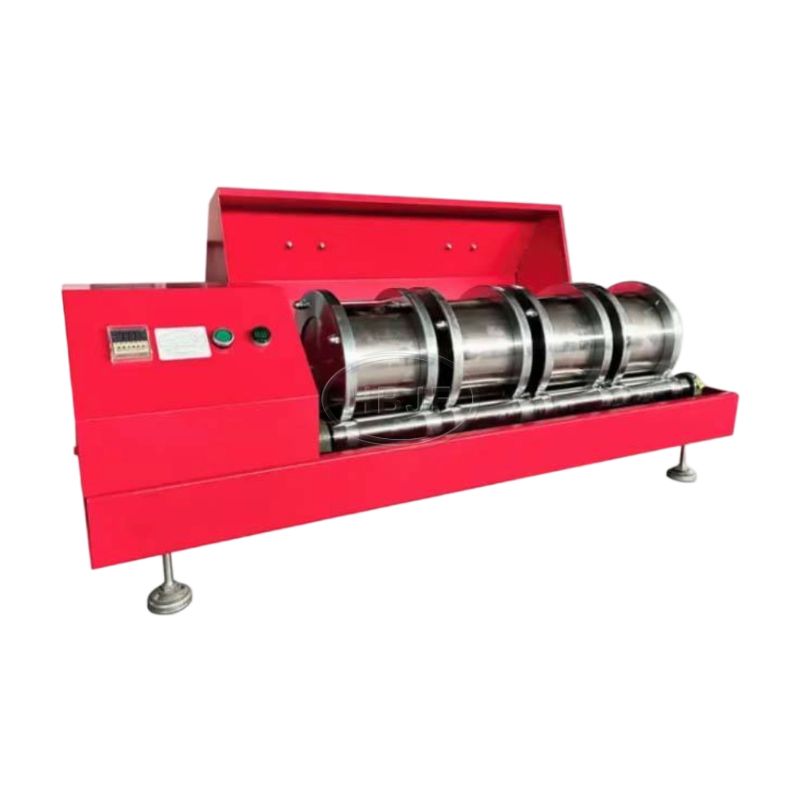
The Los Angeles Abrasion Test is a standardized method used to determine an aggregate's resistance to impact, abrasion, and grinding under dry conditions.
In the test, a specified quantity of coarse aggregate is placed inside a rotating steel drum together with hardened steel spheres.
As the drum rotates, the aggregate experiences repeated:
· Impact
· Crushing
· Abrasion
· Friction
After completing the required number of revolutions, the material is sieved to determine the percentage of weight loss.
Lower abrasion loss indicates stronger and more durable aggregates.
The LA Abrasion Test is typically conducted according to:
· ASTM C131
· ASTM C535
· AASHTO T96
· EN 1097
It remains one of the most commonly specified tests for highway and construction materials.
The Micro-Deval Test evaluates aggregate resistance to wear under wet abrasion conditions.
Unlike the LA Abrasion Test, water is added to the rotating drum, allowing the test to simulate moisture-related field conditions more accurately.
The testing procedure includes:
· A graded aggregate sample
· Steel balls
· Water
· A rotating stainless steel drum
During rotation, aggregates collide with the steel balls and one another while immersed in water.
After testing, the sample is washed, dried, and sieved to calculate the percentage of material loss.
Again, lower loss values indicate higher durability.
The Micro-Deval Test is commonly performed according to:
· ASTM D6928
· AASHTO T327
· EN 1097-1
It has become increasingly popular for evaluating aggregates used in modern pavement systems.
Although both methods assess aggregate durability, they differ in several important ways.
The LA Abrasion Test is conducted under dry conditions.
It mainly evaluates resistance to:
· Mechanical impact
· Crushing
· Dry abrasion
The Micro-Deval Test is performed in the presence of water.
It measures aggregate performance under conditions that closely resemble actual pavement environments exposed to rain, groundwater, and moisture.
The LA Abrasion Test emphasizes impact resistance and particle breakage.
The Micro-Deval Test focuses more on surface abrasion and gradual material degradation caused by friction in wet environments.
Because of these differences, the two tests may produce different rankings for the same aggregate source.
Many engineers consider the Micro-Deval Test more sensitive to differences in aggregate mineralogy and long-term durability.
It often provides a better indication of field performance for aggregates used in asphalt pavements.
Both tests require specialized Aggregate Testing Equipment, but the machines differ.
LA Abrasion machines typically feature:
· Heavy-duty steel drums
· Steel charge balls
· Dry testing operation
· High-impact rotation
Micro-Deval machines generally include:
· Stainless steel drums
· Water-resistant construction
· Precision speed control
· Wet abrasion testing capability
There is no universal answer because each test evaluates different material characteristics.
The LA Abrasion Test is well suited for:
· General aggregate quality assessment
· Highway base materials
· Concrete aggregates
· Quality control during aggregate production
It is especially useful when evaluating resistance to impact and crushing.
The Micro-Deval Test is preferred for:
· Asphalt pavement aggregates
· Surface course materials
· High-performance road projects
· Moisture-sensitive environments
Its wet testing conditions provide valuable information about long-term aggregate durability.
Many modern laboratories use both testing methods because they provide complementary information.
Combining both tests allows engineers to evaluate:
· Impact resistance
· Abrasion resistance
· Wet durability
· Long-term pavement performance
Transportation agencies increasingly specify both tests for critical infrastructure projects, ensuring comprehensive aggregate evaluation.
Choosing reliable Aggregate Testing Equipment is just as important as selecting the correct test method.
When purchasing equipment, laboratories should consider the following features.
The machine should fully comply with ASTM, AASHTO, or EN requirements to ensure test validity and acceptance.
Stable rotational speed improves repeatability and minimizes testing variability.
Industrial-grade frames, drums, and drive systems ensure long service life even under frequent laboratory use.
Modern equipment with digital timers, revolution counters, and automatic stop functions improves efficiency and reduces operator error.
Accessible components simplify cleaning, inspection, and routine servicing, reducing downtime.
Protective covers, emergency stop buttons, and overload protection contribute to a safer laboratory environment.
HBJF manufactures advanced Aggregate Testing Equipment designed for construction laboratories, universities, research centers, and quality control organizations worldwide.
HBJF equipment is engineered to deliver precise, repeatable, and standards-compliant test results.
Robust steel construction and premium components provide reliable performance under demanding laboratory conditions.
Digital interfaces simplify testing procedures, reducing training time and improving productivity.
HBJF supplies a complete range of aggregate testing instruments, including:
· LA Abrasion Testing Machines
· Micro-Deval Testing Machines
· Aggregate Crushing Value Test Equipment
· Sieve Shakers
· Density and Water Absorption Testing Equipment
· Flakiness and Elongation Gauges
This enables laboratories to perform comprehensive aggregate quality control using integrated solutions from a trusted manufacturer.
HBJF also provides installation guidance, calibration assistance, technical consultation, and responsive after-sales service to help customers maximize equipment performance.
To achieve consistent and accurate results:
· Calibrate testing equipment regularly.
· Use representative aggregate samples.
· Inspect steel balls and drums for wear.
· Follow the specified testing standard without modification.
· Record environmental conditions and testing parameters.
· Train laboratory personnel in standardized operating procedures.
Consistent testing practices ensure reliable quality control and improve confidence in material selection.
Both the LA Abrasion Test and the Micro-Deval Test are essential methods for evaluating aggregate durability, but they serve different purposes. The LA Abrasion Test measures resistance to impact and dry abrasion, making it ideal for assessing mechanical toughness, while the Micro-Deval Test evaluates wet abrasion resistance and better reflects real-world moisture conditions.
Rather than viewing the two methods as competitors, many laboratories use them together to obtain a more complete understanding of aggregate performance. By investing in high-quality Aggregate Testing Equipment from HBJF, engineers and quality control professionals can conduct accurate, repeatable, and standards-compliant testing that supports the construction of durable, safe, and long-lasting infrastructure.
Copyright:@2020-2021

Comments Please sign in or sign up to post.
0
0 of 500 characters used