
Choosing a circulating fluidized bed boiler supplier affects fuel cost, emissions control, uptime, and long-term maintenance. For plants that burn coal, biomass, sludge, or mixed fuels, an industrial circulating fluidized bed boiler supplier must provide more than a boiler pressure rating. The design must match the fuel moisture, ash content, steam demand, local emission limits, water quality, and available maintenance skills. A suitable CFB boiler supplier for biomass and coal can help the plant convert difficult fuels into stable process steam or power without creating avoidable operating risks.
Many industrial plants face the same practical problem: their available fuel is inexpensive but difficult to burn. Biomass may contain high moisture. Low-grade coal may produce large amounts of ash. Waste-derived fuels may change in composition from one delivery to the next. A boiler designed for only one narrow fuel range can lose efficiency, produce unstable steam, or require frequent shutdowns.
A circulating fluidized bed, commonly called a CFB boiler, addresses this problem through controlled suspension and circulation of solid fuel particles. Crushed fuel, limestone, and bed material are mixed with rising air. The air velocity keeps the particles moving through the furnace. Hot solids then pass into a cyclone separator and return to the combustion chamber. This repeated circulation increases the time available for combustion and heat transfer.
CFB combustion generally occurs at about 800–900°C. This is lower than the flame temperature found in many pulverized-coal systems. The lower furnace temperature helps limit thermal nitrogen oxide formation. Limestone can also be injected into the furnace to capture sulfur dioxide through calcination and sulfation reactions.
The International Energy Agency has identified higher-efficiency combustion, fuel flexibility, and emissions control as important factors in reducing the environmental impact of thermal power and industrial heat production. In practice, however, environmental performance depends on the full system. Furnace design, limestone quality, air staging, fuel preparation, ash handling, and operating control all affect the final result.
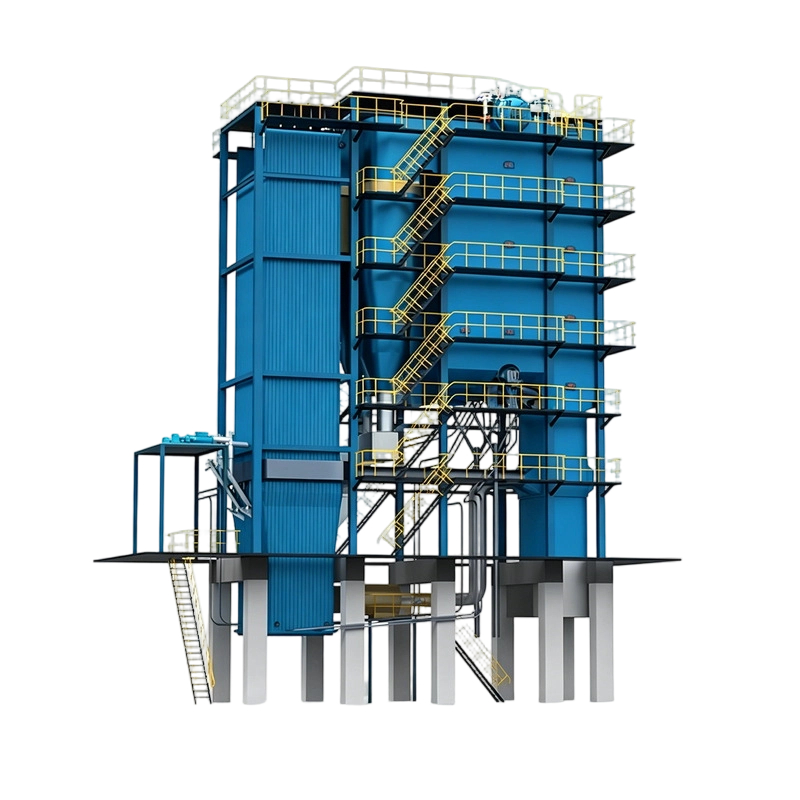
A circulating fluidized bed boiler is a steam-generating system that burns solid fuels in a fast-moving bed of particles. The bed is not a fixed layer. Instead, air carries fine fuel and ash upward through the furnace. A cyclone removes most of the solids from the flue gas and sends them back to the furnace through a return leg.
The main parts normally include:
Fuel feeding system: Delivers coal, biomass, petcoke, sludge, or blended fuel at a controlled rate.
Fluidized bed furnace: Provides the space for combustion and heat release.
Air distributor: Sends primary air into the furnace bottom to maintain fluidization.
Secondary air system: Supports staged combustion and improves burnout.
Hot cyclone separator: Separates circulating solids from the flue gas.
Return loop: Sends captured solids back to the furnace.
Water-wall tubes: Absorb radiant and convective heat from the furnace.
Superheater and reheater: Increase steam temperature for turbine or process use.
Economizer and air preheater: Recover heat from flue gas before it leaves the boiler.
Ash removal system: Controls bottom ash and fly ash discharge.
Flue gas cleaning equipment: May include bag filters, electrostatic precipitators, sulfur control, and selective or non-selective catalytic systems.
In a conventional bubbling fluidized bed boiler, the bed material stays mainly near the furnace bottom. In a CFB boiler, solids circulate through the entire furnace and return loop. This difference provides longer solids residence time, stronger mixing, and better contact between fuel, air, and limestone.
CFB boilers are used where fuel flexibility and reliable steam production are more important than using a single premium fuel. The most common applications include:
Power generation: Utility and captive power plants can burn low-grade coal, biomass, or blended fuels.
Biomass energy: Rice husks, wood waste, palm residues, and other agricultural by-products can be used when the fuel preparation system is suitable.
Industrial process steam: Paper mills, sugar factories, textile plants, chemical plants, and food-processing facilities require stable steam for production.
Waste-to-energy projects: Selected refuse-derived fuels, sludge, and industrial residues may be used after testing their heating value and ash behavior.
Mining and metals: Mining sites may use locally available coal, waste coal, or process residues.
Cement and mineral processing: CFB systems can supply steam or power while using certain industrial by-products.
District heating: Combined heat and power plants can produce electricity and hot water from one fuel stream.
Fuel flexibility does not mean that every fuel can be fed into every CFB boiler. A fuel with 45% moisture may require a different feeding and drying design from a fuel with 10% moisture. High chlorine, alkali, sulfur, or ash content can increase corrosion, fouling, agglomeration, or erosion risks. For this reason, a supplier should review representative fuel samples before confirming the furnace size and auxiliary equipment.
The value of a supplier is measured by the complete operating result, not only by the nameplate capacity. A qualified supplier should connect fuel analysis, thermal design, pressure parts, automation, emissions control, and after-sales service into one system.
CFB boilers can handle a wider fuel range than many conventional systems because the furnace provides strong mixing and long residence time. The design still needs limits for particle size, moisture, ash fusion temperature, heating value, and fuel feed rate. A supplier should state these limits in the technical offer instead of using the general phrase “multi-fuel operation.”
Operating near 800–900°C can reduce thermal NOx formation compared with higher-temperature combustion. Staged air injection can further control oxygen distribution in the furnace. Actual stack emissions depend on fuel nitrogen, excess air, furnace temperature, residence time, and downstream treatment. The supplier should provide guaranteed values based on a defined fuel and operating load.
Limestone can capture sulfur dioxide inside the furnace. The main reactions involve limestone decomposition into calcium oxide and the later conversion of calcium oxide into calcium sulfate. The required limestone-to-sulfur ratio depends on limestone purity, particle size, furnace conditions, and the required removal rate. A supplier should identify the expected limestone consumption and the impact on ash volume.
The constant movement of bed material increases contact between hot particles and heat-transfer surfaces. This helps maintain heat transfer during fuel changes, but tube erosion must be managed carefully. Protective coatings, suitable refractory, correct gas velocity, and proper cyclone design are important. The operating manual should include inspection points and recommended replacement intervals.
Many industrial users need both electricity and process heat. A CFB boiler can be connected to a back-pressure turbine, extraction-condensing turbine, or direct process steam network. The correct choice depends on the steam pressure profile, electrical demand, return condensate rate, and seasonal load. A supplier should calculate performance at design load and common part-load conditions.
A supplier cannot prepare a reliable proposal from boiler capacity alone. Send a complete technical brief before requesting a quotation. The information should include the following items:
Steam capacity: State the normal, minimum, and maximum steam flow in tonnes per hour or kilograms per hour.
Steam conditions: Include main steam pressure, main steam temperature, feedwater temperature, and any reheated steam requirements.
Fuel type: Identify coal, biomass, sludge, petcoke, waste-derived fuel, or a planned blend.
Fuel analysis: Provide moisture, ash, volatile matter, fixed carbon, sulfur, nitrogen, chlorine, heating value, ash fusion temperature, and particle size.
Fuel variation: Explain the expected minimum and maximum values instead of sending only one laboratory result.
Operating schedule: State annual operating hours, start-stop frequency, expected turndown, and whether the boiler must follow a changing process load.
Emission limits: Provide local limits for dust, sulfur dioxide, nitrogen oxides, carbon monoxide, and other regulated pollutants.
Site conditions: Include altitude, ambient temperature range, cooling water temperature, available space, seismic requirements, and wind conditions.
Water quality: Send raw water analysis, make-up water data, and condensate return conditions.
Ash requirements: Explain ash storage, ash disposal, possible ash reuse, and the maximum acceptable ash temperature.
Utility limits: List available electricity, instrument air, natural gas for startup, water, and fuel-handling equipment.
Project standards: State the required pressure-vessel code, electrical standard, inspection rules, and factory acceptance requirements.
Prepare fuel, steam, site, water, emissions, and operating data before contacting a CFB boiler supplier.
These details allow the supplier to calculate furnace volume, cyclone size, heat-transfer surface, limestone feed rate, fan capacity, ash discharge rate, and emissions-control requirements. They also reduce the risk of receiving quotations that appear similar but use different assumptions.
Once the technical information is complete, compare proposals on a common basis. The lowest purchase price may not produce the lowest cost over a 20-year operating period.
Look for clear guarantees covering steam capacity, steam temperature, boiler efficiency, fuel consumption, emissions, unburned carbon in ash, and auxiliary power use. Each guarantee should name the test fuel, operating load, ambient conditions, and measurement method.
For example, “high efficiency” is not a useful guarantee without a defined calculation basis. Ask whether efficiency is calculated by the direct or indirect method, whether ash sensible heat is included, and how moisture in the fuel is treated.
A strong proposal lists the acceptable fuel range in measurable terms. It should show the minimum and maximum moisture, heating value, ash, sulfur, particle size, and blend ratio. If the supplier cannot explain what happens when fuel quality moves outside the design range, the project may face unstable operation later.
Ask whether sulfur control is provided inside the furnace only or supported by downstream equipment. Confirm the dust collector type, filter area, design gas volume, expected pressure drop, and maintenance access. For NOx control, review air staging and determine whether additional reagent injection or catalyst systems are required.
High-velocity solids can wear furnace walls, cyclone inlets, return legs, and bends. The supplier should show the selected refractory materials, wear protection, inspection doors, and replacement strategy. Ask for records from boilers operating with similar ash and fuel conditions.
Service response affects lost production. Confirm the availability of commissioning engineers, remote support, spare parts, training, troubleshooting procedures, and planned maintenance packages. A clear list of recommended spares for two years of operation is useful during budget planning.
A reliable CFB boiler project usually follows a staged process. Skipping an early stage can create expensive changes during construction.
Send several representative fuel samples to a qualified laboratory. One sample may not show seasonal moisture, ash chemistry, or blend variation. Test ash fusion behavior because sticky ash can increase agglomeration risk in the fluidized bed.
The supplier converts the fuel data and steam demand into a heat balance. This stage determines furnace dimensions, heat-transfer surfaces, fan sizes, fuel-feed capacity, limestone consumption, and ash discharge requirements.
Review the process flow diagram, equipment list, plot plan, utility balance, control philosophy, and emissions-control arrangement. Confirm how the boiler connects to the turbine, steam header, water-treatment plant, chimney, and ash system.
Pressure parts, cyclones, refractory, fans, feeders, control panels, and flue gas equipment are then designed and manufactured. Inspection plans should cover welding, non-destructive testing, dimensional checks, refractory installation, and pressure testing.
Before firing, the project team should inspect refractory curing, tube cleanliness, valve alignment, fan rotation, instrument calibration, interlocks, fuel-feeding equipment, and ash transport routes. These checks help prevent mechanical faults during the first firing.
Startup normally uses auxiliary fuel to heat the furnace gradually. Operators then introduce the main fuel while monitoring bed temperature, furnace pressure, oxygen, carbon monoxide, cyclone temperature, steam conditions, and ash discharge. Performance testing should be completed using the agreed test fuel and load range.
CFB technology is robust, but poor preparation can still lead to operating problems.
| Problem | Typical cause | Prevention method |
|---|---|---|
| Bed agglomeration | Low ash fusion temperature, excessive local heat, or unsuitable bed chemistry | Test ash behavior, control bed temperature, manage fuel size, and monitor pressure changes |
| High carbon in ash | Large fuel particles, poor mixing, short residence time, or low furnace temperature | Improve fuel preparation, adjust air distribution, and verify solids circulation |
| Tube erosion | High solids velocity, poor flow distribution, or damaged refractory | Use wear protection, inspect high-risk zones, and maintain correct operating velocity |
| Unstable steam output | Changing fuel moisture, blocked feeders, poor control tuning, or inadequate fuel storage | Install reliable feeders, use online monitoring, and define a fuel quality range |
| High dust emissions | Improper separator operation, damaged filter bags, or overloaded dust collection equipment | Size the dust collector for maximum gas flow and maintain differential-pressure alarms |
| High auxiliary power use | Oversized fans, excessive pressure drop, or poor system integration | Review the full pressure balance and compare fan efficiency at normal load |
How many boilers of similar capacity and fuel type are in commercial operation?
Can the supplier provide references for biomass, low-grade coal, or mixed-fuel projects?
What fuel limits are guaranteed in the contract?
What boiler efficiency and emissions values are guaranteed, and under which test conditions?
How are erosion, refractory wear, and cyclone maintenance managed?
What is the expected startup time from a cold condition?
What minimum stable load can the boiler maintain?
How much limestone, bed material, auxiliary fuel, and electricity will the system consume?
Which equipment is included in the supply boundary?
What training, spare parts, software, and commissioning support are included?
How quickly can critical replacement parts be delivered?
Can the supplier support future fuel blending or capacity expansion?
When reviewing Genjux or another potential supplier, buyers should focus on technical fit rather than brand claims alone. The key evaluation points are fuel-testing capability, engineering depth, equipment integration, documented performance, quality control, commissioning support, and long-term service.
Genjux can be included in the supplier comparison process by requesting a project-specific technical proposal. The request should contain the fuel analysis, steam conditions, emission limits, site data, water quality, operating schedule, and preferred standards. A useful proposal should then show the heat balance, equipment scope, fuel envelope, guaranteed performance, delivery schedule, and list of exclusions.
Previous: How Heat Load and Circulation Rate Affect Thermal Oil Boiler Selection
Next: What Industries Benefit Most from Choosing a China Gate Valve Manufacturer for Flow Control Solution
Copyright:@2020-2021

Comments Please sign in or sign up to post.
0
0 of 500 characters used